Showing posts with label DMZ. Show all posts

September 11, 2018

The Dark Side of Korean Family Reunions

By Robert Collins


Divided families reunion. 
(Photograph Credit: Divided Families Foundation)

As we watched the first of three reunions of 89 families take place at Kumgang Mountain Resort in August, we could not help but feel sympathetic to each member of the families split apart for nearly seven decades by antithetical politics and a war that cost over two million Korean lives. Certainly, the happiness displayed by the family members at their reunion was as real as at the 20 other reunions that have taken place since 2000.

However, there is a very dark side to these reunions and that darkness emanates from the Kim regime’s use of blackmail and system of human rights denial. First, the limitations that North Korea puts on each reunion are exasperatingly restrictive, considering the fact that there are 57,000 South Korean family members, as of May, awaiting the opportunity to meet their long lost loved ones in the North. The vast majority of those 57,000 are over 70 years old. Allowing just 89 senior citizens to participate in a single reunion event is a far cry from the reunion scale needed to grant all of the separated Koreans even one visit with their family members from the other side of the DMZ prior to their passing. 

Crossing The Taedong River. Refugees fleeing from the Chinese Communist forces wade across the Taedong River near Pyongyang in North Korea, during the Korean War, 13th December 1950.
(Photograph Credit: Divided Families Foundation)

Second, the selection process on North Korea’s side is purely political and is focused on historical loyalty to the Kim regime’s Supreme Leader and the Korean Workers’ Party (KWP). Anyone with a poor loyalty record would never be selected for such reunions. Although the Kim regime’s process for selecting reunion participants from the North is not publicized, it is undoubtedly consistent with other policy decisions and security practices employed by the KWP. First, the Party decides all policy and the government implements as directed. The KWP is run by the “Party within the Party”—the Organization and Guidance Department (OGD)—which facilitates the decision-making process for the Supreme Leader and then distributes guidance to the appropriate agencies and regional institutions. In this case the primary local agencies would be the Ministry of People’s Security (North Korea’s national police force) and the KWP committee at the city or county level. The county police hold the background investigation records of every county resident. This songbun file contains the history of each individual and their family members out to a minimum of three generations, and the file is updated regularly. Relatives in South Korea would be of particular note in this file with exact detail on who these relatives are, where they are located in the South, and whether there has been any contact in the past via letters or other means.

The county party committee would have records on the political performance of each county resident and problems related to political loyalty identified during saenghwal chonghwa—life self-critique—where one confesses political and personal shortcomings for that week. The two files would then be combined to provide a report by the county party committee back to the OGD through the county party committee’s “organizational secretary.” Those chosen from the North will have been culled from these evaluations.

Third, those deemed eligible based on their political and social history would then undergo one to two weeks of intense indoctrination by the county party committee’s “propaganda secretary,” who would use a standard format provided by the KWP’s Propaganda and Agitation Department at the KWP headquarters in Pyongyang. This indoctrination would focus on appropriate talking points of praise for the Kim regime, and ensuring that the relative from the North does not betray the Kim regime by complaining about the living conditions in the North or by criticizing the regime in any way while meeting with their relative from the South.

Fourth, as the family members meet at the reunion tables provided for each family, the Kim regime deploys Party “guidance officers,” who monitor the conversations closely in order to stop perceived politically problematic discussions, and to report back up through their chain of command on the political performance of the North Korean participants.

Fifth, as there is for any North Korean that comes in contact with South Koreans on an official basis, each North Korean who participates in the reunion will undergo extended self-criticism sessions in front of county party committee and police officials to ensure that there is no incident of political misspeak that violates the pre-indoctrination themes or that the participants are not prone to betraying the Kim regime in the future.

Sixth, information from all of the aforementioned processes will be recorded in the individual citizen’s songbun file.

Last, but not least, South Korean relatives regularly give generous gifts (within guidelines worked out by officials of the two sides) to their North Korean family members. These gifts are then targeted by North Korean officials to collect as bribes to the officials in order to be lenient on the North’s reunion participants. This is reportedly a common practice in all communication between North Koreans and their relatives in the South or elsewhere overseas.

For Kim Jong-un, the fact that the families were able to be reunited stands out as a tool of influence requiring little, if any, commitment to North-South reconciliation efforts initiated at the April 27, 2018 summit meeting between Republic of Korea President Moon Jae-in and North Korean leader Kim Jong-un. Re-enforcing the loyalty of the North’s oldest residents is the dark side of that tool.

June 21, 2017

Former UN COI Chair Kirby on the Death of Otto Warmbier

By The Honorable Michael Kirby


The Honorable Michael Kirby is the former chair of the United Nations Commission of Inquiry on Human Rights in the Democratic People's Republic of Korea.

SYDNEY INSTITUTE 

SYDNEY, 21 JUNE 2017 

BEYOND THE TRAGEDY OF OTTO WARMBIER

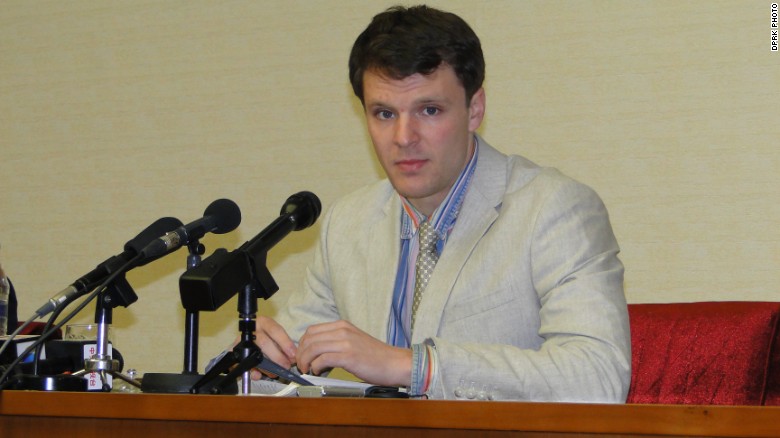
Image Credit: CNN

This week the family of Otto Warmbier announced, in their polite, understated American way, “It is our sad duty to report that our son has completed his journey home. Otto died today at 2pm.”

The apparently healthy, well-nourished American university student from Wyoming, Ohio, made a fateful decision in China at the end of 2015. Instead of returning directly to his studies at the University of Virginia, he signed up for a short trip to the ‘hermit kingdom.’ His idea was to spend the New Year break in North Korea. During his stay at a Pyongyang hotel, he entered a staff room which was off bounds. He removed a propaganda banner that lauded the achievements of the Korean Workers’ Party and proclaimed undying loyalty to the ‘Great Leader,’ Kim Jong-un.

This act, doubtless conceived as a cheeky gesture, was not perceived that way by the North Korean authorities. The young Otto was arrested and separated from his group who left for home. He began his journey into grossly excessive punishment. He was tried and obliged to tender abject apologies. He was sentenced to 15 years hard labour. He joined other, mostly American, prisoners whose extreme punishments were probably designed to serve as inducements for outlandish concessions and to signify humiliation and submission. During 18 months of detention something happened that plunged Otto into an unresponsive coma. A deal was struck last week to return the comatose prisoner to his family. Wyoming, Ohio welcomed him back. But he died without recovering responsiveness. Otto Warmbier was foolish in the way that young people can sometimes be. But his jailers were brutal, secretive and neglectful. His ‘punishment’ was totally disproportionate. Proportion and moderation are features of universal human rights and democratic politics. They are not features of the society of North Korea that the young Otto so offhandedly decided to visit as a New Year lark. The tour company has now cancelled tours for Americans. The family condemn what they see as the wrong done to their son by North Korea. The world looks on and draws its conclusions.

In May 2013, I was appointed to chair a UN commission of inquiry on human rights violations in North Korea. Nothing in my previous 35 years as a judge in Australia had prepared me for the ‘systematic, widespread and gross human rights violations’ that were disclosed in the evidence about the conditions in that country. We were denied entry by the regime. We never expected that they would submit themselves to close up inspection. However, we had no problem gathering reliable and convincing evidence. More than 30,000 North Korean refugees are now living in South Korea where they have a constitutional right to citizenship. In understated public testimony, available online, many of them came forward to tell a horror story of what is going on in their country.

North Korea is a land of ceaseless propaganda. Of torture and inhuman treatment. Of arbitrary arrest and detention. Of public executions to which school children are brought to look and to learn what happens to state enemies. Detention camps exist where family members must join the accused so as to rid society of their contagion. It is a place where freedom of movement is strictly controlled. Where Korean, Japanese and other nationals have been abducted to serve the purposes of the Kim dynasty. Where starvation of thousands is a recurring nightmare because of the failures of the economic system, a left-over of the world’s last Stalinist society.

North Korea rejects the evidence and findings of the UN inquiry about the gulags containing the ‘hostile class’. Yet they reject UN demands to permit inspectors to examine the places we can identify. Satellite images confirm the testimony provided by our witnesses. In today’s world it is less easy than once it was to hide widespread wrongdoing.

After the UN report was delivered to the Human Rights Council in March 2014, it was impossible to deny, with any conviction, the serious state of affairs in North Korea. According to our findings ‘the gravity, scale and nature of these violations reveal a State that does not have any parallel in the contemporary world.’ It is ‘a totalitarian State: a State that does not content itself with ensuring the authoritarian rule of a small group of people, but seeks to dominate every aspect of its citizens’ lives and terrorises them from within.’

The young Otto Warmbier had been specifically told by the tour company that he should not go into staff quarters in his hotel. He had been warned of the hyper-sensitivity of North Korea’s leadership to slights and to challenges to their leadership. Perhaps, as in his own country, that was just the challenge he needed to make his sudden, gesture to pilfer the propaganda symbol. But North Korea is a pitiless place. Especially so for uppity, well-fed American tourists. What he was not counting on was the pervasiveness of surveillance and the subordination of elite hotel employees to loyalty to their Leader.

Young Otto did not suffer detention in the political camps. His fate was incarceration in the ordinary prison system of the country. If, before setting out to Pyongyang, he had read the report of the UN commission on North Korea, he would have learned of the findings of grossly inhumane acts committed there against ordinary prisoners. Of extermination and murder, torture, rape and other grave sexual violence happening in the prisons. Of conditions similar to enslavement which persist behind prison walls. Of shocking shortages of food and hygiene. And the crimes against humanity that are a feature of daily life in North Korea. Had he read our report, he might have thought twice about going to such a country to celebrate the New Year. And if he had gone, he would have been aware of the brutality that attends trivial infractions, especially by foreigners, particularly by Americans. But he was just a high spirited student with his life ahead of him. Suddenly by an act he would have regarded as harmless, he became a dispensable pawn in a great international chess game.

A seemingly minor player on the geographical chess board (North Korea) has suddenly aspired to be a King. Despite comparative poverty and disadvantage it has developed nuclear warheads. It has tested sophisticated missiles. It has experimented with submarine launching facilities that will allow it to threaten more than its neighbours. The established players in the game do not seem to know how to declare checkmate to this new would-be King. A tiny pawn, like Otto Warmbier, can quite easily be removed from the game, and even from life. When and how the young Otto’s brain damage first occurred may never be known. Like much else about North Korea, it is shrouded in obsessive secrecy and mystery. Perhaps this is what intrigued Otto and caused him to take his fateful decision.

How should we remember Otto Warmbier from Ohio? His plight should draw our attention to the sufferings of an entire people subjected in North Korea to daily acts of fearsome disproportion and violence. Accidently perhaps, Otto’s incarceration, coma, removal and death, once again, call to notice the sufferings of the other prisoners, languishing in the jails of North Korea. A young American’s fate becomes a metaphor, a kind of symbol, of a big story about thousands of nameless statistics locked up and oppressed in North Korea. They are voiceless. But Otto Warmbier speaks of their suffering from his grave. He reminds the world of the human rights wrongs in North Korea. He joins the voices of the many witnesses who gave testimony to the UN commission.

The young Otto never woke from his coma to tell of his ordeal. Still the image of this healthy, strapping American student, joyfully speaking at his high school graduation on YouTube, is a reminder of all the other victims who remain behind. They are locked up in their prisons, their detention camps and elsewhere behind the DMZ in the closed society that is North Korea. They will remain locked up in that silence until the United Nations and the world community respond effectively to the UN Commission report.

In 1945, the world promised that never again would it turn away from crimes against humanity. That promise has not yet been delivered. We owe it to Otto Warmbier, but also to the people of North Korea who still live in the shadows, to deliver on the promise. The development of nuclear weapons in North Korea makes fidelity to the promise more difficult. But also more important and more urgent. The boy from Wyoming, Ohio tells the world that it should act. But will it? Can it? That is the puzzle left to humanity by the life and death of Otto Warmbier.

August 10, 2015

Lenin’s Theory of Utility

By Robert Collins


The concept of manipulating others to promote one’s own cause is no doubt millennia old.  It is not an original thought by Lenin.  Those that employed this concept likely existed in the ancient Egyptian dynasties, the Roman Empire and most other political realms, as well as Lenin’s establishment of the communist domain.  Utility is a fascinating concept that somewhat defies logical description – support for an external cause through belief that one’s vision of right will prevail though it contradicts political reality.

Lenin’s theory of utility is based in those that find benefit and comfort from others who are willing to deceive themselves about another’s intent in order to comfort themselves in their view of the world.   To feel good about one’s contribution to a false premise is indeed comforting if one chooses to either ignore reality or choose not to accept political discomfort.  In one recent case, choosing to support the values of human rights denial versus support for the defense of democracy and human rights based upon one’s observation that “I talked to them and they seemed real and sincere” is to ignore human dignity and succumb to the propaganda of deception.

When Code Pink and WomenCrossDMZ visited North Korea they did so without having an appreciation for Lenin’s theory.  The fact that these women met and conversed with North Korean women was apparently, in their minds, a major victory for human rights if one believes their testimony once they crossed the DMZ.  Women of note from among those that crossed praised their opportunity to speak to North Korean leaders and agree that the term “human rights” was included in their statement.  Was there utility for the North Koreans to agree to do so?

Within the context of North Korea’s propaganda-dominated diplomacy, the answer would most certainly be yes.  To be sure, Lenin would have been proud to include it in a statement that had no impact on the reality of his rule.  The same goes for the Kim Family Regime. The North Korean woman who talked to a representative of Code Pink or WomenCrossDMZ was surely not so fortunate to be so self-deceived.  The North Korean woman, or group of women, whom the DMZ crossers so eloquently praised was prepped to say what the party-state wanted them to say – to the last syllable.  That woman has been indoctrinated since she was in pre-school on how to think, what to say, and how to obey the party.  She met her first official propagandist at the age of seven and listened to that person present how the United States was evil to the core and South Korea was merely puppets in the hands of Washington, DC.  Her parents were compelled to listen to the propaganda put out by the education director at every level, the neighborhood unit chief in every local community, and the individual work-line propagandist who gave verbal feedback to everything they admitted during daily and/or weekly self-critique sessions. She has been compelled throughout her lifetime to do the same as her parents. She studied how North Korea’s supreme leader was always right and all had to worship him and do his bidding by serving the wishes of the Korean Workers’ Party.  And yes, that they had to comply with the collective and do so through self-reliance.  But self-reliance in North Korea is more akin to survival in an environment of unparalleled political terror, rather than self-motivation. Even if she had learned that what she heard was absurd – and it is – the secret police prepped her for every meeting and debriefed her on every word that was said.  Every meeting that the Code Pink/WomenCrossDMZ had with individual North Koreans was planned, rehearsed and vetted before it took place. Every North Korean engager of the Code Pink/WomenCrossDMZ was required to report what they heard from every North Korean in their small team, not to mention that based on the secret police’s well-known tactics, there were several undercover secret police female officers within the group as well.

What benefit is there for the Kim Regime in doing this?  The party and the police state control “the happening” and learn how to do a better job with those that serve Lenin’s Theory of Utility by developing such sub-theorems as Kim Jong-un’s Theorem on Manipulating Western Naiveté, or secret police commander General Kim Won-hung’s Theorem on Personal Deception.

How do we know of this propaganda, deception and the employment of the utility theory?  Every one of the 27,000 North Korean defectors to South Korea has told us as much – in great detail.  Their testimony of human rights denial, political terror, and mental and physical brutality are legion.  Every one of them understands Lenin’s Theory of Utility.  Apparently, such theories are beyond the understanding or at least the appreciation of Code Pink/WomenCrossDMZ.  Useful? You bet…just ask the 27,000.

March 23, 2014

The Loopcast Interviews HRNK Executive Director Greg Scarlatoiu


The Loopcast interviews HRNK Executive Director Greg Scarlatoiu on March 22, 2014. The following are the links to the podcast.

On The Loopcast website: http://www.theloopcast.com/2014/03/22/a-look-into-north-korea/

On iTunes: https://itunes.apple.com/us/podcast/the-loopcast/id592320085?mt=2

January 03, 2014

North Korea Human Rights Outlook for 2014… ‘Concerning of Political Camps Expansion and Reign of Terror’

By Voice of America (VOA)


At Panmunjeom, south of the DMZ, a visitor is watching video footage of a political prison camp in North Korea.

People point out that the North Korean human rights issue deteriorated last year. We examine how the human rights situation will pan out in the new year with journalist Yung-kwan Kim.

Anchorman: There were many occurrences inside and outside North Korea which affected human rights last year, weren’t there?

Journalist: Yes, there were. The UN Human Rights Council established the UN Commission of Inquiry (COI) on North Korean human rights, which brought a lot of attention to the issue. However, the situation of those attempting to defect is worsening as surveillance, punishment and overall control of the people are on the increase. The execution of Jang Song-thaek was an example of the strengthening of Kim’s regime through “fearpolitik.”

An anchorman: What is your view on North Korea human rights issues this year?

Journalist: Many human rights organizations anticipate that the human rights situation in North Korea will not improve this year. Greg Scarlatoiu, Executive Director of the Committee for Human Rights in North Korea, pointed out three trends indicating that the outlook for this year is not bright.

[Tape-recording: Scarlatoiu] “ I do not anticipate spectacular improvements”
First, the Kim regime has intensified the crackdown on attempted defections in the border region between China and North Korea. Second, Kim has continued to exercise his “fearpolitik,” his reign of terror as we observed in the Jang Song-thaek execution and purging of associates. Third, the restructuring of the political prison camps will continue, and the number of prisoners will likely increase, due to the other two trends.”

Anchorman: It seems that North Korea’s dismal and deplorable human rights situation will continue this year.

Journalist: That is right. Human rights organizations are especially concerned with the possibility of an expansion of the political prison camps. The UN and human rights organizations estimate the current number of prisoners to be between 80,000 and 120,000, but that number is likely to increase.

Anchorman: Why do you think it will increase?

Journalist: That is because Kim Jong Un, the first secretary of the KWP secretariat, has been trying to strengthen his own regime through measures including the execution of his own uncle. According to sources inside North Korea, those families who were close to Jang Song Thaek have been imprisoned in political prison camp 15 at Yoduk. South Korean Minister of Unification Ryu Gil-jae also said, on December 30, that the purge in North Korea continues.

An anchorman: You mean to say that there may be more prisoners now because of the purge and the “reign of terror?”

Journalist: Yes. Some say that Jang’s execution brought more light to the human rights issue than even the UN Commission of Inquiry (COI). The execution has reminded the international community about political prison camps in North Korea. What we have learned is that North Koreans who attempted to defect to South Korea but were apprehended are no longer held in Kyohwaso (long-term prison labor facilities where prison terms are generally assigned), but in Kwanlisos (political prison camps, where imprisonment is generally indefinite). North Koreans caught watching or distributing smuggled South Korean TV shows have also been sent to political prison camps or executed. Due to these developments, the number of political prisoners is likely to increase.

An anchorman: What kind of response do you anticipate from the international community?

Journalist: The international community will strengthen their pressure against North Korea more than ever. That is because the UN Commission of Inquiry (COI) will release their final report about the North Korea human rights. Here is a comment by Greg Scarlatoiu, Executive Director at The Committee for Human Rights in North Korea, about the UN Commision of Inquiry’s report.

“If the UN Commission of Inquiry establish that……”

[Taping-recording: Greg Scarlatoiu] “If the UN Commission of Inquiry establishes that…”

If the UN Commission of Inquiry’s final report confirms that the North Korean regime has been committing crimes against humanity, the international community will intensify efforts to focus attention on North Korean human rights violations, and step up the pressure meant to bring about positive change.

Anchorman: What stage is the COI’s final report in?

Journalist: According to UN sources in Geneva contacted yesterday (December 31st), the first draft will be completed around the middle of January, and it will be viewed by members of the council of the United Nations. The report will be finalized in mid-February, and it will be officially submitted to the U.N. Human Rights Council in March.

Anchorman: What is the UN’s next step after releasing the final report?

Journalist: It depends on the result of the final report. The report’s recommendation will be essential in eliciting an international response. If determined that crimes against humanity have been committed, this could lead to further debate within the U.N. The UN Security Council could refer the case to the International Criminal Court. However, experts estimate that China and Russia will not be on board. Because of this, other suggestions have been made, such as creating a U.N. ambassadorship to North Korea, tasked with promoting human rights and managing humanitarian assistance, including North Korean human rights issues in the permanent agenda of the U.N. Security Council, together with the nuclear issue, or establishing a special tribunal similar to the one established to address the Khmer Rouge genocide in Cambodia.

Anchorman: Many nonprofit organizations were very active last year. What do you think about this year?

Journalist: I anticipate that these nonprofit organizations will be more active this year. Human Rights Watch, headquartered in New York, is currently looking to hire a Seoul-based researcher. Amnesty International, headquartered in New York, is planning on expanding its field research. The Committee for Human Rights in North Korea, headquartered in Washington, D.C., is planning on continuing its collaboration with organizations with a longstanding tradition of addressing human rights abuses, such as Holocaust Museums in the United States, aiming to dismantle North Korea’s political prison camps.

Anchorman: We have looked at what the international community should do regarding North Korean human rights in 2014, with journalist Kim Young-kwan.