
Anti-Leaflet Law in South Korea & Freedom of Expression in North Korea
[Policy Report from the Office of Tae Yong-ho]
January 5, 2021
Tae Yong-ho, Member of the National Assembly
(the People Power Party)
<Table of contents>
Introduction
1. The Constitution of the Republic of Korea and the Amendment to the Development of Inter-Korean Relations Act (“Anti-Leaflet Law”)
Article 4 of the Constitution of the Republic of Korea
Enactment Process of the Anti-Leaflet Law
Freedom of Expression vs. Lives and Safety of South Korean Residents in the Border
2. The Legal Problems with the Anti-Leaflet Law
Laws on Inter-Korean Exchange and Cooperation
The Development of Inter-Korean Relations Act
Criticism from the International Community
Government Stance on the Criticism from the International Community
3. The Reality of the Right to Freedom of Expression in North Korea
North Korean Legal Structure
Compulsory Political Activities
Juche Ideology of North Korea
Religious Policy of North Korea
State Control on Outside Information
4. Recent Changes in North Korea
Active Flea Markets
Korean Wave (Hallyu) in North Korea
Adoption of Law on Rejecting Reactionary Ideology and Culture
Conclusion
Introduction
I am honored to have been given an opportunity to serve my country, the Republic of Korea, as a member of the National Assembly. However, just four years ago, I was North Korea’s former deputy ambassador to the United Kingdom. But in 2016, I defected to South Korea with my family in search of freedom, leaving behind all privileges rendered to me. But the turning point in my life did not just happen overnight. My perspectives on the world have been shaped by the time I had spent traveling between Pyongyang and various European capitals every three to four years as a North Korean diplomat. Years of living abroad have completely transformed my belief in the North Korean system and eventually influenced my decision to defect to the South, one of the most flourishing democracies in the world.
In fact, it was the elite education in North Korea that first opened my eyes to the outside world. In my teens, I was lucky enough to attend a foreign language school in Pyongyang, usually reserved for the children of the country’s elite ruling class, where we were even shown American cinema. Enthralled, I remember humming Edelweiss from The Sound of Music created by U.S. imperialists, our sworn enemies. It was a tiny opening that eventually led to my family’s flight to freedom during my posting in London in 2016 following in the von Trapp family’s footsteps.
The leaflets flown north in balloons from the inter-Korean border area have likewise been an invaluable source of information for those trapped behind the Juche curtain. Having learnt about the Kim Jong-Un regime’s opulence and its self-serving diversion of resources into weapons of mass destruction over the welfare of its people, some vote with their feet by escaping a life of oppression in North Korea; others elect to stay but remain aware that there are alternatives.
Pyongyang knows this too. Perhaps that is why it has been apoplectic about leaflets even by North Korean standards. On October 10, 2014, North Korean forces opened fire on balloons carrying leaflets. In June 2020, Pyongyang threatened military action for South Korea’s failure to ban leafleting.
North Korea has made a series of threats against the sending of leaflets along border. The newly amended provisions of the Development of Inter-Korean Relations Law, colloquially known as the “anti-leaflet law,” goes far beyond in its banned items and geographic scope. The South Korean authorities have belatedly suggested issuing legally dubious “interpretive guideline” to narrow the application, but they have been silent about revising the law. The government also likes to cite inter-Korean agreements to end leafleting but they do not cover activities by private citizens or groups.
Nor do I share the government’s expectation that the anti-leaflet law will “contribute to the improvement of inter-Korean relations and promotion of peace on the Korean Peninsula”. Instead, bending over backwards to appease totalitarian rulers may embolden them to ask for more as Hitler did after the 1938 Munich agreement. What assurance is there that Pyongyang would not promise reprisals for sending of Bibles or South Korean movies through China?
I am deeply grateful to the South Korean people for warmly welcoming my family, guaranteeing my life, liberty and the pursuit of happiness, and giving me the privilege and honor of representing my electors. None of the “people’s deputies” in North Korea would dare to speak against a government bill let alone filibuster it.
The North Korean people are entitled to the same freedoms that I have enjoyed for the past four years here and its realization will be the surest guarantee of human rights and democracy, peace and prosperity in South Korea in the long term. As Martin Luther King Jr. wrote, “injustice anywhere is a threat to justice everywhere.”
That is why I ask your support to stand with human rights defenders in speaking up against the anti-leaflet law and protecting freedom of expression in North and South Korea before it comes into force on 30 March 2021.
This special report on the anti-leaflet law has been prepared to aid your understanding of several legal issues surrounding the amendment in light of the Constitution and international law and of brutal reality of freedom of expression in North Korea. The report concludes that the anti-leaflet law is extremely problematic for three fundamental reasons. First, it undermines democracy by restricting freedom of information in North Korea. Second, the law suppresses human rights and religious freedom. Third, it also restricts freedom of expression, a fundamental right protected by the Constitution of South Korea.
The Republic of Korea is one of the extremely rare countries among the colonized that achieved both industrialization and democracy. It is the law of nature that water flows from high to low points. The same could be said about the two Koreas. It is the law of nature that North Korean citizens, oppressed under the authoritarian rule of Kim Jong-un, accept free and democratic values of the South. The freer and democratic North Korea becomes, the sooner peaceful unification will arrive in the Korean peninsula.
I will continue to fight against all attempts to blind North Korean people to the truth. I sincerely hope that you will join me in this important endeavor.
January 5, 2021
Tae Yong-ho, Member of the National Assembly (the People Power Party)
1. The Constitution of the Republic of Korea and the Amendment to the Development of Inter-Korean Relations Act (“Anti-Leaflet Law”)
Article 4, Constitution of the Republic of Korea
Article 4 of the Constitution of the Republic of Korea reads that “the Republic of Korea shall seek unification and shall formulate and carry out a policy of peaceful unification based on the basic free and democratic order.” As stated in the Constitution, the North Korea policy, therefore, should be based on the two pillars of ‘free and democratic order and peace,’ because after all, the most important duty of the President is to defend the Constitution.
If the Constitution seeks to establish peaceful unification, North Korean people should be given more opportunities to learn about democracy and build ethnic affinity with fellow South Koreans. The decision to voluntarily give up soft power that has earned the hearts of the North Korean people, specifically through the South Korean cultural wave (Hallyu), will only serve to undermine the constitutional pillar of ‘the basic free and democratic order.’
The Enactment Process of the Anti-Leaflet Law
The psychological warfare between the two Koreas first began during the Korean War. The government-led distribution of leaflets halted when Kim Dae Jung administration agreed to halt the activity to meet a precondition for the June 15th Inter-Korean summit. Kim’s successor, former President Roh Moo-hyun followed suit and agreed in 2004 to stop propaganda activities along the inter-Korean border and to remove all tools and means that facilitate such activities. Government-mandated ban on the sending of leaflets led to a rise of civilian-led launching of leaflets.
In the Panmunjom Declaration signed on April 27, 2018, President Moon Jae-in and Chairman Kim Jong-un agreed to cease all hostile acts against each other in order to defuse acute military tensions that had built up. Such acts included the loud-speaker broadcasting and scattering of leaflets in the areas along the Military Demarcation Line (MDL).
In fact, the distribution of leaflets by civilians contributes to promoting the rights to know of the North Korean people. The downside is that it could cause inter-Korean tension. For instance, on Oct 10, 2014, the North Korean army fired some 10 bullets with anti-aircraft guns at balloons carrying leaflets launched in Yeoncheon County, to which the South Korean military responded with return fire. Whenever North Korea ramped up its threat, past South Korean administrations responded with either prohibiting the launching of leaflets with police force or attempting to dissuade civic groups from sending leaflets at all. However, each time the government made such attempt, it received fierce criticism from the public, mainly because no legal basis existed to ban leaflet-launching activities. The government ban on the sending of leaflets would have violated freedom of expression, a fundamental right protected by the Constitution.
There have been eight motions to amend the Inter-Korean Exchange and Cooperation Act from years between 2008 and 2018 which aimed to prohibit the launching of leaflets to North Korea. However, all motions received criticism and were later discarded on the ground that they violated the basic right protected by the Constitution.
What changed the dynamics was when Kim Yo-jong, the sister of North Korean leader Kim Jong-un, demanded that the South Korean government make laws to ban the sending of leaflets by activist groups consisting of defectors. Since her statement on June 4, 2020, the legislative process to enact the anti-leaflet law progressed rapidly. She threatened to shut a joint liaison office and factory town in the border town of Kaesong or discard the inter-Korean comprehensive Military Agreement (CMA), if the South Korean government failed to take necessary action.
In response to Kim Yo-jong’s demand, South Korean Ministry of Unification quickly held a press briefing and announced that all activities that endanger the lives and property of residents living in the border should be prohibited and that it was preparing to take steps to improve current legislation that can fundamentally correct the situation, signaling that it would hastily enact the anti-leaflet law in order to completely ban the leaflet drop.
Both the South Korean public and international community denounced the anti-leaflet bill, calling it ‘legislation made under the single order of Kim Yo-jong’ and ‘legislation that guards authoritarian Kim Jong-un.’ They demanded the government retract its decision to pursue the legislative process. For example, Tomás Ojea Quintana, United Nations’ Special Rapporteur on the situation of human rights in North Korea, advised the two Koreas to work together to resolve the leaflet issue, while Signe Poulsen, head of the Seoul office of the UN Office of High Commissioner for Human Rights, commented that the sending of leaflets is an activity intended to deliver information to North Korean citizens and thus a form of individual freedom of expression.
However, despite North Korea’s demolishing of a joint liaison office in Kaesong on June 16, the government introduced a bill to the general meeting of the Foreign Affairs and Unification Committee of the National Assembly on August 3. On September 22, a South Korean civil servant from the Ministry of Oceans and Fisheries was killed by North Korean soldiers while on duty, and his body was incinerated. Although the South Korean government did not even receive an assurance from Pyongyang that North Korea would take action to punish the perpetrators and prevent similar cases from occurring again, South Korea did not participate in the joint committee for the adoption of resolution on situation of human rights at UN General Assembly. On December 2, the anti-leaflet law passed with majority voting for the bill. What happened was that the super-majority of the ruling Democratic Party forcibly passed the bill, disregarding and breaking a conventional rule of passing the bill only with an agreement between the ruling and opposition parties in a Foreign Affairs and Unification subcommittee a day before the vote.
The anti-leaflet law passed the vote in the general meeting of the National Assembly on December 14. The bill was then debated and deliberated (Dec 22), approved by the President (Dec 24), promulgated (Dec 29), and is set to take effect three months after promulgation, resulting in the birth of unjust law that outrightly denies the spirit of the Constitution. While the ruling party and the government claim that this is a minimal step necessary to protect the lives and safety of South Korean residents in the border, legal experts on domestic and international law, human rights activists, US Congressmen, and media criticized the passage of the bill as one that severely restricts the rights of individual to speak freely, a basic constitutional right.
Freedom of Expression vs. Lives and safety of South Korean Residents in the Border
The South Korean government and ruling party pointed out that the distribution of leaflets should be banned, as it endangers the lives and safety of South Korean citizens living along the border. However, this is an extremely weak argument in light of the Constitution, international law, and legal views of the National Human Rights Commission of South Korea, a national advocacy institution for human rights protection.
The Republic of Korea Constitution states that “all citizens shall enjoy freedom of speech and the press, and freedom of assembly and association (Clause 1, Article 21).” Nevertheless, the extent to an individual can express his or her freedom is not without limit. The Constitution also reads that “the freedoms and rights of citizens may be restricted by Act only when necessary for national security, the maintenance of law and order or for public welfare (Clause 2, Article 37).” The distribution of leaflet can escalate military tension between the two Koreas and may violate the right to live of the residents in the border.
In fact, Defector A argued in a court case that government prohibition on the distribution of leaflets caused psychological damage to him. The South Korean Supreme Court ruled in 2016 that causality exists between the act of sending leaflets and provocation of North Korea which could directly incur bodily harm and imminent danger to the lives of residents in the border region. Therefore, it confirmed the original verdict that dismissed a claim for damages, ruling that the government can limit the leaflet sending activity under the Act on the Performance of Duties by Police Officers and civil law.
The government frequently cites this court case to support the legality of the anti-leaflet law. However, the Supreme court ruling was merely that it was not unlawful for the police to stop individuals from sending leaflets, but not that individuals who distribute leaflets should be criminalized. In particular, the ruling reads that ‘it was not unlawful unless the restriction is not excessive,’ leaving ample avenue for the law to not violate freedom of expression. Hence, this court ruling does not provide legal evidence to justify the government claim that prohibiting and criminalizing an act of distribution leaflets is legally sound.
A report titled ‘Legal Response and Task of the Distribution of Leaflets’ published by the Korea Institute for National Unification, a national research institution, concludes that “the distribution of leaflets goes beyond the bound of the right to freedom of expression and can already be limited by existing legislation. If a special law was to be enacted, it should be reviewed thoroughly from legal and policy perspectives so that it does not violate the principle of excess prohibition laid out in the Constitution.”
The report also added that “if a special law that prohibits and criminalizes the sending of leaflets is to be introduced, it should be drafted and written with much precision to ensure all constitutional requirements are met. Otherwise, it will be vulnerable to the claim of unconstitutionality.”
Article 19 of the Universal Declaration of Human Rights (a.k.a. the International Covenant Civil and Political Rights) states that “the right to freedom of opinion and expression includes freedom to hold opinions without interference and to seek, receive and impart information and ideas through any media and regardless of frontiers. Both South Korea and North Korea are the parties to the Covenant. International law is not legally binding, but carries the same force as domestic law; therefore, the two Koreas have the responsibility and duty to ensure and protect the right to freedom as defined in the Universal Declaration of Human Rights as stated in the Covenant.
Moreover, the National Human Rights Commission of Korea concluded in the 2nd plenary committee in 2015 that the sending of leaflets by civic groups or individuals is a form of freedom of speech. It also expressed a view that the government should not monitor or deter the distribution of leaflets by individuals or civic groups, since threat from North Korea or the agreement between the two Koreas to stop slander or defamation of each other cannot be used to restrict basic civil liberties. This view takes into consideration the safety of South Korean citizens, including those who live in the border region.
In conclusion, the Constitution, international law, and legal view of the National Human Rights Commission all point out that existing law is sufficient to restrict the sending of leaflets, and even if the enactment of special law is necessary to prohibit such an act, it should be carefully drafted to not violate the principle of excess prohibition as stated in the Constitution.
2. The Legal Problems with the Anti-Leaflet Law
Laws on Inter-Korean Exchange and Cooperation
It was the Inter-Korean Exchange and Cooperation Act that the National Assembly enacted to regulate the distribution of leaflets in 2008. The prescribed purpose of the law was to define activities necessary to promote mutual exchange and cooperation. Therefore, critics of the legislation pointed out that the sending of leaflets, an act of unilateral expression of opinion, cannot be regarded as an act to promote inter-Korean exchange and cooperation, and therefore, does not fulfill the intended purpose of the legislation.
Moreover, contrary to “the exchange, contact, and trade with North Korea” as stipulated in the Inter-Korean Exchange and Cooperation Act, the act of sending leaflets to North Korea is ‘prohibited in principle,’ which damages the unity of law itself.
Furthermore, since the sending of leaflets is a form of expression of opinion, all-out prohibition and stipulating a penalty clause of such an activity by law could be considered as pre-censorship which may violate constitutional right to speech.
For the reasons above, a total of eight proposed amendments to the Inter-Korean Exchange and Cooperation Act in the years between 2008 and 2018 were all discarded.
The Development of Inter-Korean Relations Act
When Kim Yo-jong denounced the distribution of leaflets in her statement on June 4, the South Korean government announced that it was preparing to review legislation that can fundamentally improve all legislation that intensifies tension along the inter-Korean border. The proposed law that followed was an amendment to the Development of Inter-Korean Relations Act. The legislation defines an act of spreading leaflets as a violation of the terms of the inter-Korean agreement and stipulates criminal penalties for committing such an act.
In other words, while the Inter-Korean Exchange and Cooperation Act seeks to ban the act of sending leaflets by requiring approval from the Minister of Unification, the Amendment to the Development of Inter-Korean Relations Act is intended to fundamentally prohibit the distribution of leaflets by defining it as a violation of the inter-Korean agreement and criminalizing that activity.
The main provisions added to the Development of Inter-Korean Relations Act are as follows:
| Article 4 (Definitions) 5. “Leaflets and other items” are defined as, items (including but not limited to advertising propaganda materials, printed materials, auxiliary memory units), cash and other means of property gains. 6. “Scattering” is defined as distributing leaflets to unspecified individuals in North Korea or move them to North Korea without obtaining approval under Article 13 or 20 of ‘Inter-Korean Exchange and Cooperation Act’for propaganda, donation, etc (leaflets sent to North Korea simply via a third country is also included). Article 24 (Prohibition of Violation of the Inter-Korean Agreement) (1) No person shall harm the lives or bodies of the people or cause serious danger by doing any of the following acts. 1. Loudspeaker broadcasting toward North Korea in areas along the Military Demarcation Line. 2. Posting visual materials (posts) toward North Korea in areas along the Military Demarcation Line. 3. Scattering leaflets and other items ② The Minister of Unification may, if necessary to prevent prohibited acts under each subparagraph of paragraph (1), request cooperation from the head of the relevant central administrative agency or the head of a local government. In such cases, the head of the relevant central administrative agency or the head of a local government shall cooperate, except in extenuating circumstances. Article 25 (Penalty Provisions) ① Any person who has violated Article 24 (1) shall be punished by imprisonment for not more than 3 years or by fine not exceeding 30 million won. However, the provision shall not apply when South-North Korean agreements are suspended (this shall be limited to actions prohibited by Article 24 (1)) based on Article 23 (2) and (3). ② A person who has attempted any crime under paragraph (1) shall be punished. |
First of all, Subparagraphs 5 and 6 of Article 4 are problematic for the following reasons:
5. “Leaflets and other items” are defined as, items (including but not limited to advertising propaganda materials, printed materials, auxiliary memory units), cash and other means of property gains.
Clause 5 reads that “Leaflets and other items” include items, cash and other means of property gains. This means that the law prohibits sending not only leaflets, but virtually all items to North Korea, which is clearly beyond the scope of legislative intent, as the government claims. The South Korean government argues that these items were included in the legislation, as balloons carrying leaflets could include dollar notes, mini-radios, and flash drives. However, it is not convincing why cash and items which are in fact a form of economic aid to help ordinary North Korean citizens, are banned along with leaflets that Pyongyang has denounced so severely.
In other words, the inclusion of “other items” in the amendment demonstrates that the government claim that this law is intended to protect South Korean citizens living in the border by prohibiting “an act of distributing leaflets and other items” that “condemns” North Korea is clearly flawed.
6. “Scattering” is defined as distributing leaflets to unspecified individuals in North Korea or move them to North Korea without obtaining approval under Article 13 or 20 of ‘Inter-Korean Exchange and Cooperation Act’ for propaganda, donation, etc. (leaflets sent to North Korea simply via a third country is also included).
According to the definition of “scattering” as laid out in Clause 6, the act of “scattering” already implies that any person who engages in such an act did not obtain approval for taking out or bringing in goods, etc. (Article 13) and for operating transportation equipment (Article 20) from the Minister of Unification as stipulated in the Inter-Korean Exchange and Cooperation Act.
In the meantime, any person who takes out or brought in goods, etc. or operates transportation equipment between South Korea and North Korea without prior approval from the government is punished by imprisonment for not more than three years or by a fine up to thirty million won under the Inter-Korean Exchange and Cooperation Law.
| INTER-KOREAN EXCHANGE AND COOPERATION ACT Article 27 (Penalty Provisions) (1) Any person who falls under any of the following subparagraphs shall be punished by imprisonment for not more than three years or by a fine up to thirty million won: 1. Any person who visits North Korea without obtaining approval under Article 9 (1) and the provision to Article 9 (6); 2. Any person who obtains approval under Article 9 (1) and the proviso to Article 9 (6) by fraud or other improper means; 3. Any person who takes out or brought in goods, etc. without obtaining approval under Article 13 (1); 4. Any person who carries out any cooperative project without obtaining approval under Article 17 (1); 5. Any person who operates transportation equipment between South Korea and North Korea without obtaining approval under Article 20 (1); 6. Any person who obtains approval under Article 13 (1), 17 (1) or 20 (1) by fraud or other improper means. |
There has already been a legal debate in the judiciary on whether the sending of leaflets to North Korea is subject to approval under the Inter-Korean Exchange and Cooperation Law. In fact, courts have interpreted and determined that the sending of leaflets is not subject to approval from the Minister of Unification. In response to the court rulings, the government has tried to punish individuals who engaged in the distribution of leaflets under other laws such as the High-Pressure Gas Safety Control Act and Wastes Control Act.
However, the newly amended anti-leaflet law now makes the distribution of leaflets legally subject to government approval by defining the term “distribution/spread,” which could cause controversy on the interpretation of the law.
Article 24 (Prohibition of Violation of the Inter-Korean Agreement) (1) No person shall harm the lives or bodies of the people or cause serious danger by doing any of the following acts.
1. Loudspeaker broadcasting toward North Korea in areas along the Military Demarcation Line.
2. Posting visual materials (posts) toward North Korea in areas along the Military Demarcation Line.
3. Scattering leaflets and other items
Essentially, an act of sending any materials of value to North Korea in China-North Korea border without approval from the South Korean government will constitute an act of scattering leaflets and other items under Subparagraph 3, Paragraph 1, Article 24.
Article 25 (Penalty Provisions) ① Any person who has violated Article 24 (1) shall be punished by imprisonment for not more than 3 years or by fine not exceeding 30 million won. However, the provision shall not apply when South-North Korean agreements are suspended (this shall be limited to actions prohibited by Article 24 (1)) based on Article 23 (2) and (3).
② A person who has attempted any crime under paragraph (1) shall be punished.
An act of sending leaflets to North Korea (particularly sending leaflets in China-North Korea border) itself does not directly involve danger that causes bodily harm to South Korean citizens. It is, in fact, North Korea’s hostile act including military provocation that causes serious harm or threat to the lives of South Korean citizens.
The basic principle of criminal law is that in order to impose criminal punishment on a person for committing a specific act, that act should infringe upon another person’s benefit and protection of law. However, the amendment to this law is unusual in that the legislation punishes an individual not for the act he or she has committed, but depending on a reaction from a third party.
As a result, one receives criminal punishment if his or her sending of leaflets has led North Korea to engage in an act of hostility. On the other hand, if North Korea showed no reaction, then that person would not receive punishment. Such arbitrary penalty provisions could be problematic in consideration of the principle of legality in criminal law.
Another potential issue is a penalty provision for attempted crime as stated in Subparagraph 1, Paragraph 2, Article 25. In other words, even if the sending of leaflets did not cause “harm or serious danger to the lives and body of citizens,” an individual can be investigated, prosecuted, and tried for having the intent to do so. Moreover, another ambiguity is with the interpretation of Paragraph 2 of Article 25; it is not clear whether the attempted crime refers to an attempt to spread leaflets and other materials or an attempt to incur harm or danger to citizens.
The amendment has been promulgated on Dec 29, 2020 and is set to take effect in three months. All legislative process has been completed, and only the interpretation of the law remains on the table. The Ministry of Unification is working on ‘interpretive guidelines,’ but as an executive branch, it has no authority whatsoever to substitute for a role of the judicial branch charged with interpreting the law.
Criticism from the International Community
In his unusual op-ed in a South Korean conservative newspaper, Tomás Ojea Quintana, United Nations' Special Rapporteur on the situation of human rights in North Korea, urged that South Korea should reconsider the legislation before it goes into effect. His main concern was that the penalty provision of a maximum three years of imprisonment for sending leaflets violates individual right to expression. In his article, Special Rapporteur Quintana requested the South Korean government and National Assembly yet another review of the legislation before its enforcement.
Mr. Quintana commented that “there must be justification for restricting freedom of expression, and such restriction should be applied proportionately.” He added that the legislation used ambiguous terms such as ‘advertising propaganda materials’ and ‘other means of property gains,’ arguing that the use of those terms challenges the standards of international human rights which do not allow margin of appreciation when it comes to freedom of speech.
On Dec 14, several US Congressmen including Chris Smith (R-NJ), Co-chair of the bi-partisan Tom Lantos Human Rights Commission, Michael McCaul (R-TX) and Gerald E. Connolly (D-Va.) have expressed criticism for the anti-leaflet law. Congressman Chris Smith called the legislation “insane,” urging the South Korean government to review critically its commitment to democratic values. He also declared that he intended to convene a congressional hearing regarding this issue.
Former U.S. Representative Eliot Engel (D), Chair of the House Foreign Affairs Committee, commented in his recent interview with Voice of America that while he “recognizes the importance of building trust between the two Koreas,” he does not believe that building trust should come “at the expense of a common goal of promoting human rights in North Korea.” Mr. Engel added that he “hopes to work together with the South Korean government to resolve any issues that may arise as a result of the enactment of this legislation.”
Robert R. King, former Special Envoy for North Korea human rights issues at the U.S. Department of State, warned in his commentary submitted to the Center for Strategic & International Studies, that “there is no assurance that even with the silencing of freedom of expression in banning balloons that the North Koreans will take any action to improve inter-Korean relations. The consequence, however, could be erosion of the South Korean relationship with the United States, which is important for the people of both countries.”
Politicians and human rights activists from outside of the U.S. have also joined the force in expressing their criticism for the anti-leaflet law.
In the United Kingdom, David Alton, a British politician who represents All Party Parliamentary Group on North Korea, urged Secretary of State Dominic Raab to send formal request to the South Korean government to reconsider the decision to enact the anti-leaflet law.
Similarly, Canada also expressed its concern over the passage of the bill. Christelle Chartrand, spokesperson for Global Affairs Canada, commented that “Freedom of expression is a cornerstone of prosperous society and a critical element in the promotion of human rights.” Similar views were found in Europe. Human Rights Without Frontiers, a non-government organization based in Belgium, stated that it would send EU leadership an official statement that requests EU member states to officially protest against the passage of the anti-leaflet law.
In Japan, the Asahi Shimbun published an editorial titled ‘The Moon Jae-in administration should consistently protect the principle of freedom.’ The article stated that the anti-leaflet law “includes provisions that damage the principle of civic freedom and democracy.” It concluded that while “democracy may differ from a country to country, the South Korean government should take a cautious action regarding the new amendment because it will not be free from the voice and concern of the international community with regards to issues on conventional values such as freedom and democracy.”
Official Stance of the South Korean Government on the Criticism from the International Community
When the anti-leaflet bill officially became law on Dec 15, critics pointed out that the amended law ‘criminalizes even the distribution of flash drives containing Korean dramas.’ The Ministry of Unification quickly issued a statement, refuting the claim that the law does not prohibit such an act.
The Ministry argued that the amended law, which critics have called ‘legislation made with a direct order from Kim Yo-jong,’ was not enacted because of the demand from Pyongyang, but to fulfill basic government duty to protect the lives and safety of its citizens. It also emphasized that this law is necessary to perform constitutional obligation of promoting substantial development of the inter-Korean relations and peace in the Korean peninsula and pursuing a policy for peaceful unification.
The Ministry added that “while freedom of speech is a constitutional right, it does not prevail over the right to live of our own citizens who live along the border.”
The Ministry of Unification also stated that “expressing Seoul’s commitment to comply with the inter-Korean agreement through the systematic enactment of the amended law could effectively call on and encourage North Korea to abide by the inter-Korean agreement.”
Moreover, the Ministry explained that the phrase of ‘leaflets sent to North Korea simply via a third country’ refers to a case where leaflets launched from the South Korean territory are sent into North Korea via territory of a third country. It also added that this amended law is to prohibit an activity that causes serious harm to the lives of our citizens, pointing out that an act of launching leaflets in a third country will be governed by the national law of that country, not the amended legislation of South Korea.
However, the Ministry of Unification has no authority to make legal judgment on how the law is interpreted and enforced. The judiciary branch does. Therefore, it is inappropriate for the Ministry, an executive branch, to interpret the law on behalf of the courts.
The Ministry of Unification announced that it is working to provide 'guidelines for interpreting new regulations on launching leaflets and other materials' before the law takes effect. However, doing so would be acknowledging that the bill is not without fault, given that it requires specific guidelines to be fully understood.
South Korean Foreign Minister Kang Kyung-wha said in her recent interview with CNN that “some people argue that the law violates freedom of expression, but while such freedom is absolutely vital to human rights, it’s not absolute.” She further argued that freedom of expression can be limited for the safety of people.
Ruling Democratic Party Chairman Lee Nak-yon of South Korea expressed his regret over the decision of US Congress to urge the Korean government to review the amendment (of the Inter-Korean Development Act). In fact, the South Korean government has been working to prevent the worst case scenario from happening, that is, being labeled as a human rights abuser. The government has frequently convened high-level meetings chaired by Director of National Security Office Suh Hoon. In particular, the Blue House is making all-out efforts to prevent the holding of a US congressional hearing, being organized by the Tom Lantos Human Rights Commission by utilizing international media outlets. As part of its effort, the government has urged the international community to take into consideration ‘the distinct characteristics of the inter-Korean relations’ and ‘suffering of South Korean residents living along the border.’
However, factual evidence clearly suggests that there is no causality between an act of distributing leaflets and its impact on the lives and safety of residents. First, not a single human casualty occurred due to an act of sending leaflets. Second, the passage of the new amendment is unnecessary since existing law could already restrict the act.
3. The Reality of the Right to Freedom of Expression in North Korea
North Korean Legal Structure
In the North Korean legal system, Kim Jong-un’s directives and guidelines come first before any law. Below Kim Jong-un’s directives is the ‘10 principles to protect the one and only leader,’ basic bylaws of the Korean Workers’ Party, followed by the Constitution, sublaws and enforcement decrees of each administrative branch.
Compulsory Political Activities
In North Korea, all citizens are forced to engage in political activities for their lifetime. North Korean people are taught that they are born with two lives: a physical life rendered to them by their biological parents and political life, aka spiritual life, from the supreme leader of North Korea.
Regardless of the age of the people, the political activities of all North Korean citizens are controlled by the Korean Workers’ Party. The required membership in the Party enables the state to control the daily lives of citizens. Moreover, their private lives are under complete control of the state monitoring, as no criticism whatsoever of the state is permitted. All North Korean citizens receive punishment for taking part in any type of anti-state activities or even expressing opposition to the state policies. They also get reward for reporting anyone suspected of committing an anti-state crime.
Juche Ideology of North Korea
The Juche ideology of North Korea is commensurate with a religious one. It postulates that ‘man is the master of his own destiny.’ However, since a man is an individual, men must be organized centrally in order to achieve their full potential. It is the Party that forms and manages such a central organization. The Juche ideology states that since the Party is a collection of the masses, the Kim family must lead the organization.
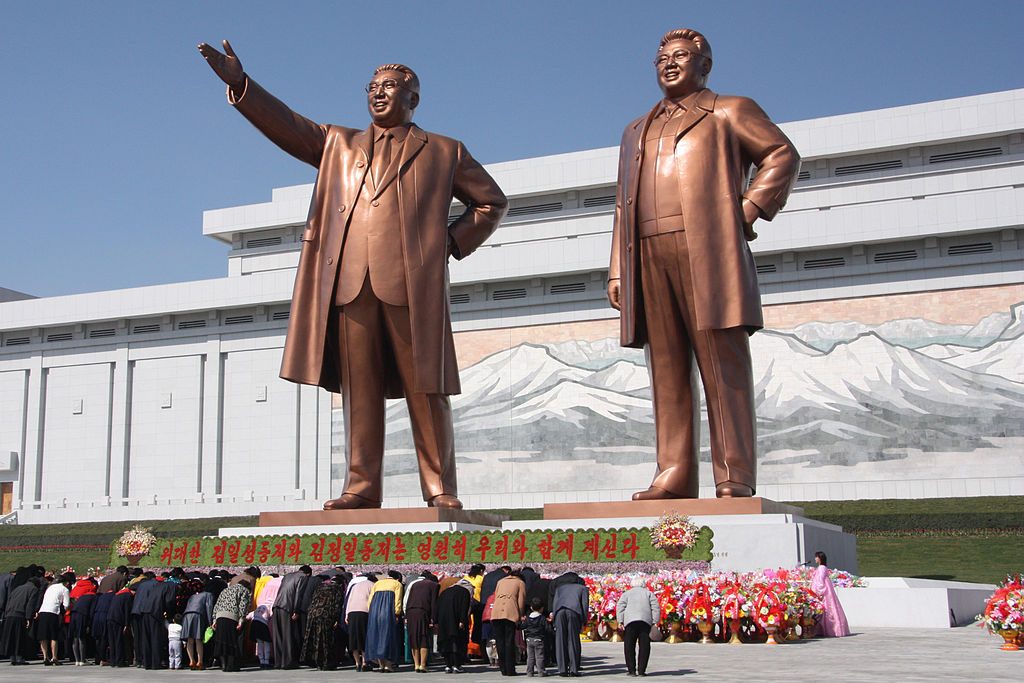
In North Korean society with extreme vertical organizational structure, the Kim family has indoctrinated the North Korean people that all citizens should pay allegiance and faith to the Kim family, the brain of all lives, in order for them to effectively manage the state. This is why there are numerous statues of Kim Il-sung and Kim Jong-il in every corner of North Korea, to which North Koreans are forced to pay tribute on a daily basis.
North Korea has institutionalized an ideological education that seeks to make North Korean people worship and pay blind allegiance to the Great Leaders, effectively blocking all access to outside information unrelated to the Juche ideology. Political propaganda in North Korea is utilized to instigate nationalistic hostility towards the enemies of the state, namely the United States, South Korea, and Japan.
Religious Policy of North Korea
Karl Marx claimed that "religion is the opium of the people." This dictum served as a basis for communism to suppress any religious activities. However, the only communist country that obliterated religion is North Korea.
While the Soviet Union, communist countries in Eastern Europe, and China persecuted religious activities, they still allowed the existence of churches and pastors.
Pyongyang, once called Jerusalem of the East, is now devoid of all religious institutions, as the North Korean regime completely banned all churches and executed clerics under its policy of exterminating all religions. Churches that now exist in North Korea such as Bong-su Church, Cil-gol Church, and Jang-choong Catholic Church were all built after 1988, the year Seoul Olympics was held. In order to compete against South Korea that successfully hosted the Olympics, North Korea organized the 13th World Festival of Youth and Students in Pyongyang just a year after the Seoul Olympics were held. Building these churches targeted foreign visitors who visited Pyongyang to attend the Festival, an attempt by the North Korean regime to make a false appearance that religious activities are tolerated in the country.
State Control on Outside Information
North Korean citizens are deprived of the right to access independent information that is not sourced from the state. The only provider of information in North Korea is the state-controlled media. The state strictly controls internet access as well as TV and radio broadcasting. All broadcasted materials go through watertight inspection by the state and are rejected, if they are not in line with the principles of the Korean Workers’ Party. All private phone calls are monitored, while ordinary citizens are only allowed to make domestic calls. North Korean people are punished for watching or listening to foreign media, including foreign films and dramas.
3. Recent Changes in North Korea
Active Flea Markets
The major change in North Korea has taken place in an upward manner, not the other way around as could be seen in the cases of East Germany, Soviet Union, and China.
The main force leading the upward change is Jang-ma-dang, flea markets in North Korea which first emerged at the end of 1990s. Following the collapse of the Soviet Union, foreign assistance plummeted, resulting in widespread famine struck North Korea in the mid-1990s. Millions of North Koreans, who relied exclusively on state food rationing, died in hunger. They started to sell whatever they had in an empty lot in their town in order to survive. The emergence and rise of Jang-ma-dang was the birth of capitalism in North Korea.
The state authority could not stop North Korean citizens from engaging in such commercial activities, when it could not even provide enough food to the people. The North Korean regime also tolerated Jang-ma-dang activities in order to secure national budget by collecting tax from sellers in the market.
Despite strict state crackdown and high price, South Korean products are extremely popular among North Korean residents. Numerous products ranging from flash drives containing Korean films and dramas, cosmetics, hanbok (traditional Korean costumes worn on special occasions such as wedding), and underwear are smuggled into North Korea and sold in Jang-ma-dang. Even state inspectors take bribery and turn a blind-eye to the illegal sale of South Korean products in the flea market which has raised a concern among North Korean officials.
Korean Wave (Hallyu) in North Korea
The infusion of South Korean culture in North Korea since early 2000 through Jang-ma-dang has transformed the lives of North Koreans. Thanks to the Korean Wave, the worldviews and cultures of North Korea have slowly resembled those of the South. Moreover, with technological progress, more North Koreans now have mobile phones and video cameras at home.
For example, a young North Korean couple used to call each other ‘Mr. or Miss Comrade,’ a term used in communistic society. However, the millennial generation, influenced by South Korean films and drama, instead use a South Korean expression such as ‘Oppa or Honey’ to address each other. In addition, young North Koreans use South Korean colloquial expressions such as ‘ㅋㅋ, ㅎㅎ (meaning lol)’ in text messages. Fashion style among young North Koreans has also started to resemble that of young people in South Korea. Three pillars of revolution, ideology, technology, and culture, which the North Korean regime have promoted for internal solidarity are shaken to the core, thanks to the Korean Wave.
Adoption of Law on Rejecting Reactionary Ideology and Culture
North Korean state media reported in an article titled ‘Invisible fight, silent war’ on Oct 19, 2019 that the state is faced with a silent war. The article warned the public that while North Korea, which possess nuclear weapons, may not be vulnerable to a physical attack, the inflow of South Korean media content such as films and dramas could topple down the state. It described the spread of South Korean culture as a “virus invading the body.”
For this reason, North Korea passed a series of law on ‘rejecting reactionary ideology and culture’ at a plenary meeting of the Supreme People’s Assembly. The intent of the law, the media reported, was to prevent the spread of anti-socialist ideology and safeguard North Korea's spirit and culture.
Conclusion
Since 2000, the two Koreas have focused on promoting exchange and cooperation, breaking away from an ideological conflict inherited from the Cold War. The thawing relations greatly reduced leaflet sending activities organized by the South Korean government. Civic groups, on the other hand, started to distribute leaflets by launching balloons along the inter-Korean border.
North Korea has continued to denounce the leaflet launching by various civic groups in South Korea and demanded Seoul to prohibit such activities. The South Korean government responded that restricting these activities would be in violation of the right to freedom of expression as specified in the Constitution. In response, North Korea threatened to use military force and eventually demolished the inter-Korean Liaison Office on June 16, escalating tension between the two Koreas.
The South Korean National Assembly, which consists of the super-majority of the ruling Democratic Party, forcibly passed the anti-leaflet bill. The bill was then debated and deliberated (Dec 22), approved by the President (Dec 24), promulgated (Dec 29), and is set to take effect within just three months.
The South Korean public and international community demanded the law be rescinded, criticizing the legislation for violating the right to freedom of expression protected by the Constitution and international law. They have also argued that this ambiguous law will cause legal controversy on the interpretation and enforcement of the law. Human rights activists in South Korea announced that they would file a petition to the Constitutional Court, as the law is slated to take effect in upcoming March.
The South Korean government argued that restriction of the basic constitutional right is inevitable to protect the lives and safety of residents who live in the border. Moreover, it maintains that freedom of right is not absolute and that it will continue to make effort to dissipate public concern by publishing guidelines for interpreting the newly amended law. However, one can reasonably conclude that the true intention of the Moon Jae-in administration for amending the law in such a hurried manner was to initiate a dialogue with Pyongyang in desperate attempt to appease to Kim Jong-un. The fact that there has been no human casualty incurred by the sending of leaflets weakens their claim.
Article 4 of the Constitution of the Republic of Korea reads that “it shall seek unification and shall formulate and carry out a policy of peaceful unification based on the basic free and democratic order.”
North Korean people have been enslaved, having been blocked from the outside world under the brutal line of hereditary dictatorship of the Kim family in the past 70 years. However, they have started to recover their basic rights as human beings by independently maintaining their means of living through commercial activities in Jang-ma-dang. The inflow of South Korean culture smuggled into North Korea has contributed to reducing hostility towards South Korea and rebuilding ethnic identity as one Korean people.
For regime survival, North Korea has vigorously sought to control the inflow of outside information into the country by enacting new laws on rejecting reactionary ideology and culture on December 4.
The South Korean government, if it was sincere about protecting freedom and democratic values that the nation as a whole has worked so hard to build, should rescind its decision to enact the anti-leaflet law which hampers peaceful unification in the Korean peninsula. The least it should do is to remove unconstitutional provisions and work to make far more meticulous laws that can satisfy the original legislative intent, that is, to protect the lives of residents living in the border region. This law should not serve to blind the North Korean people suffering under the brutal dictatorship of the Kim family.
Compulsory Political Activities
In North Korea, all citizens are forced to engage in political activities for their lifetime. North Korean people are taught that they are born with two lives: a physical life rendered to them by their biological parents and political life, aka spiritual life, from the supreme leader of North Korea.
Regardless of the age of the people, the political activities of all North Korean citizens are controlled by the Korean Workers’ Party. The required membership in the Party enables the state to control the daily lives of citizens. Moreover, their private lives are under complete control of the state monitoring, as no criticism whatsoever of the state is permitted. All North Korean citizens receive punishment for taking part in any type of anti-state activities or even expressing opposition to the state policies. They also get reward for reporting anyone suspected of committing an anti-state crime.
Juche Ideology of North Korea
The Juche ideology of North Korea is commensurate with a religious one. It postulates that ‘man is the master of his own destiny.’ However, since a man is an individual, men must be organized centrally in order to achieve their full potential. It is the Party that forms and manages such a central organization. The Juche ideology states that since the Party is a collection of the masses, the Kim family must lead the organization.
In North Korean society with extreme vertical organizational structure, the Kim family has indoctrinated the North Korean people that all citizens should pay allegiance and faith to the Kim family, the brain of all lives, in order for them to effectively manage the state. This is why there are numerous statues of Kim Il-sung and Kim Jong-il in every corner of North Korea, to which North Koreans are forced to pay tribute on a daily basis.
North Korea has institutionalized an ideological education that seeks to make North Korean people worship and pay blind allegiance to the Great Leaders, effectively blocking all access to outside information unrelated to the Juche ideology. Political propaganda in North Korea is utilized to instigate nationalistic hostility towards the enemies of the state, namely the United States, South Korea, and Japan.
Religious Policy of North Korea
Karl Marx claimed that "religion is the opium of the people." This dictum served as a basis for communism to suppress any religious activities. However, the only communist country that obliterated religion is North Korea.
While the Soviet Union, communist countries in Eastern Europe, and China persecuted religious activities, they still allowed the existence of churches and pastors.
Pyongyang, once called Jerusalem of the East, is now devoid of all religious institutions, as the North Korean regime completely banned all churches and executed clerics under its policy of exterminating all religions. Churches that now exist in North Korea such as Bong-su Church, Cil-gol Church, and Jang-choong Catholic Church were all built after 1988, the year Seoul Olympics was held. In order to compete against South Korea that successfully hosted the Olympics, North Korea organized the 13th World Festival of Youth and Students in Pyongyang just a year after the Seoul Olympics were held. Building these churches targeted foreign visitors who visited Pyongyang to attend the Festival, an attempt by the North Korean regime to make a false appearance that religious activities are tolerated in the country.
State Control on Outside Information
North Korean citizens are deprived of the right to access independent information that is not sourced from the state. The only provider of information in North Korea is the state-controlled media. The state strictly controls internet access as well as TV and radio broadcasting. All broadcasted materials go through watertight inspection by the state and are rejected, if they are not in line with the principles of the Korean Workers’ Party. All private phone calls are monitored, while ordinary citizens are only allowed to make domestic calls. North Korean people are punished for watching or listening to foreign media, including foreign films and dramas.
3. Recent Changes in North Korea
Active Flea Markets
The major change in North Korea has taken place in an upward manner, not the other way around as could be seen in the cases of East Germany, Soviet Union, and China.
The main force leading the upward change is Jang-ma-dang, flea markets in North Korea which first emerged at the end of 1990s. Following the collapse of the Soviet Union, foreign assistance plummeted, resulting in widespread famine struck North Korea in the mid-1990s. Millions of North Koreans, who relied exclusively on state food rationing, died in hunger. They started to sell whatever they had in an empty lot in their town in order to survive. The emergence and rise of Jang-ma-dang was the birth of capitalism in North Korea.
The state authority could not stop North Korean citizens from engaging in such commercial activities, when it could not even provide enough food to the people. The North Korean regime also tolerated Jang-ma-dang activities in order to secure national budget by collecting tax from sellers in the market.
Despite strict state crackdown and high price, South Korean products are extremely popular among North Korean residents. Numerous products ranging from flash drives containing Korean films and dramas, cosmetics, hanbok (traditional Korean costumes worn on special occasions such as wedding), and underwear are smuggled into North Korea and sold in Jang-ma-dang. Even state inspectors take bribery and turn a blind-eye to the illegal sale of South Korean products in the flea market which has raised a concern among North Korean officials.
Korean Wave (Hallyu) in North Korea
The infusion of South Korean culture in North Korea since early 2000 through Jang-ma-dang has transformed the lives of North Koreans. Thanks to the Korean Wave, the worldviews and cultures of North Korea have slowly resembled those of the South. Moreover, with technological progress, more North Koreans now have mobile phones and video cameras at home.
For example, a young North Korean couple used to call each other ‘Mr. or Miss Comrade,’ a term used in communistic society. However, the millennial generation, influenced by South Korean films and drama, instead use a South Korean expression such as ‘Oppa or Honey’ to address each other. In addition, young North Koreans use South Korean colloquial expressions such as ‘ㅋㅋ, ㅎㅎ (meaning lol)’ in text messages. Fashion style among young North Koreans has also started to resemble that of young people in South Korea. Three pillars of revolution, ideology, technology, and culture, which the North Korean regime have promoted for internal solidarity are shaken to the core, thanks to the Korean Wave.
Adoption of Law on Rejecting Reactionary Ideology and Culture
North Korean state media reported in an article titled ‘Invisible fight, silent war’ on Oct 19, 2019 that the state is faced with a silent war. The article warned the public that while North Korea, which possess nuclear weapons, may not be vulnerable to a physical attack, the inflow of South Korean media content such as films and dramas could topple down the state. It described the spread of South Korean culture as a “virus invading the body.”
For this reason, North Korea passed a series of law on ‘rejecting reactionary ideology and culture’ at a plenary meeting of the Supreme People’s Assembly. The intent of the law, the media reported, was to prevent the spread of anti-socialist ideology and safeguard North Korea's spirit and culture.
Conclusion
Since 2000, the two Koreas have focused on promoting exchange and cooperation, breaking away from an ideological conflict inherited from the Cold War. The thawing relations greatly reduced leaflet sending activities organized by the South Korean government. Civic groups, on the other hand, started to distribute leaflets by launching balloons along the inter-Korean border.
North Korea has continued to denounce the leaflet launching by various civic groups in South Korea and demanded Seoul to prohibit such activities. The South Korean government responded that restricting these activities would be in violation of the right to freedom of expression as specified in the Constitution. In response, North Korea threatened to use military force and eventually demolished the inter-Korean Liaison Office on June 16, escalating tension between the two Koreas.
The South Korean National Assembly, which consists of the super-majority of the ruling Democratic Party, forcibly passed the anti-leaflet bill. The bill was then debated and deliberated (Dec 22), approved by the President (Dec 24), promulgated (Dec 29), and is set to take effect within just three months.
The South Korean public and international community demanded the law be rescinded, criticizing the legislation for violating the right to freedom of expression protected by the Constitution and international law. They have also argued that this ambiguous law will cause legal controversy on the interpretation and enforcement of the law. Human rights activists in South Korea announced that they would file a petition to the Constitutional Court, as the law is slated to take effect in upcoming March.
The South Korean government argued that restriction of the basic constitutional right is inevitable to protect the lives and safety of residents who live in the border. Moreover, it maintains that freedom of right is not absolute and that it will continue to make effort to dissipate public concern by publishing guidelines for interpreting the newly amended law. However, one can reasonably conclude that the true intention of the Moon Jae-in administration for amending the law in such a hurried manner was to initiate a dialogue with Pyongyang in desperate attempt to appease to Kim Jong-un. The fact that there has been no human casualty incurred by the sending of leaflets weakens their claim.
Article 4 of the Constitution of the Republic of Korea reads that “it shall seek unification and shall formulate and carry out a policy of peaceful unification based on the basic free and democratic order.”
North Korean people have been enslaved, having been blocked from the outside world under the brutal line of hereditary dictatorship of the Kim family in the past 70 years. However, they have started to recover their basic rights as human beings by independently maintaining their means of living through commercial activities in Jang-ma-dang. The inflow of South Korean culture smuggled into North Korea has contributed to reducing hostility towards South Korea and rebuilding ethnic identity as one Korean people.
For regime survival, North Korea has vigorously sought to control the inflow of outside information into the country by enacting new laws on rejecting reactionary ideology and culture on December 4.
The South Korean government, if it was sincere about protecting freedom and democratic values that the nation as a whole has worked so hard to build, should rescind its decision to enact the anti-leaflet law which hampers peaceful unification in the Korean peninsula. The least it should do is to remove unconstitutional provisions and work to make far more meticulous laws that can satisfy the original legislative intent, that is, to protect the lives of residents living in the border region. This law should not serve to blind the North Korean people suffering under the brutal dictatorship of the Kim family.


.jpg)


