Showing posts with label hrnkus. Show all posts

April 13, 2018

Kim Family Regime Portraits

By Hye-soo Kim*
Edited by Rosa Park, HRNK Director of Programs and Editor
Translated by Grace Kan, HRNK Research Intern


This year in 2018, Kim Il-sung’s birthday falls on Sunday, April 15th. His birthday is called the “Tae-yang-jeol” (태양절), which translates as “The Day of the Sun.” He was born in 1912 in Pyongyang at Mangyeongdae, where tourists are forced to visit and bow. This Sunday will be the most important holiday of the year in North Korea. All North Koreans will bow down to the portrait of Kim Il-sung, or face grave consequences.

When you go to Beijing, the capital of China, you can see a huge portrait of Mao Zedong in the middle of the city. You see such portraits commonly in communist countries. However, no other country except North Korea has statues of the totalitarian leaders in every city. Besides statues, in every North Korean city, portraits of Kim Il-sung and Kim Jong-il are hung in every single factory, business, military branch, school, and home.

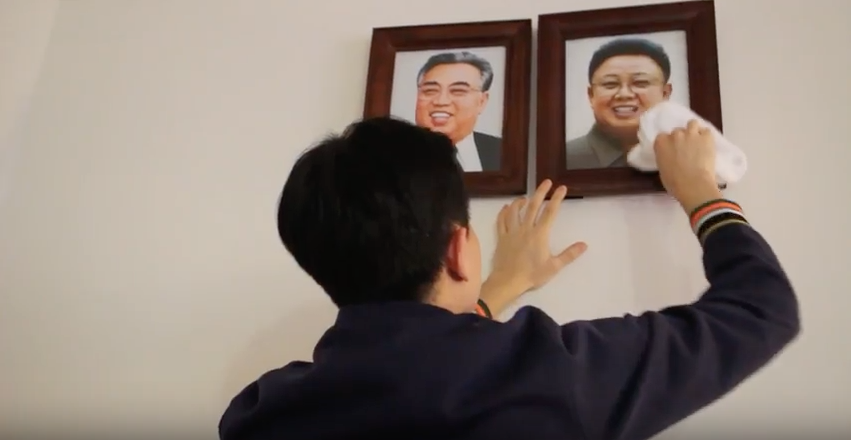
The homes in other countries differ dramatically from those in North Korea. What truly stands out the most is how in every home, without exception, there hang the portraits of Kim Il-Sung, Kim Jong-Il, Kim Jong-Un, and Kim Jung-Suk. Every family in North Korea must display the portraits in their homes; no one can refuse this. It is forbidden to have even just one speck of dust on the portraits because inspectors, who are the head of the in-min-ban (neighborhood watch units), come to inspect the status of the portraits in each and every home two to three times a month. In addition, monthly and quarterly, people called the “geu-roo-ppa” (그루빠) also do a surprise visit and check the status of the portraits. They go to each home randomly, without any prior notice. As a result, North Koreans need to always make sure that these portraits are kept clean. If the portraits are not clean, as in there is any speck of dust found on them, then the families are punished and are chastised in front of everyone in the town or village to be criticized during an event called “sa-sang-tu-jaeng” (사상투쟁). I am still in disbelief that this is common practice in North Korea. It is unacceptable.

In kindergarten, little children have to bow to the portraits. For example, the birthdays of Kim Il-Sung and Kim Jong-Il are the most important holidays in North Korea. For these days, North Korean authorities provide candies and snacks for children, from toddlers to kindergarteners. These snacks and candies are usually of poor quality and aren’t even tasty, but nonetheless, the children have to thank the dictator by bowing down to the portraits. The children do so without question because they consider it to be normal and also because the adults tell them to do so. These snacks are provided for North Korean children up until they are in elementary school. When elementary students are given these snacks and candies, they must make sure that their school uniforms are even neater than usual, gather around in the school field, and sing idolizing songs about Kim Il-sung and Kim Jong-il.


To view HRNK's first episode of With Love, Your North Korean Neighbor, please click here.

*Pseudonym for the safety of the author and the author’s family.

February 01, 2018

HRNK's EXCLUSIVE First Interview with Ji Seong-ho after SOTU Appearance as Guest of FLOTUS Melania Trump

Interview by Rosa Park, HRNK Director of Programs and Editor


Tell us about your escape from North Korea. We heard many details in President Trump's State of the Union speech, but tell us more. How long did it take you to escape? What was your path of escape?

It took me about three months to escape from North Korea to South Korea. The distance of the route that you must take is over 10,000 kilometers (about 6,214 miles). On the journey, I had to pass through a number of countries such as China, Laos, Myanmar, and Thailand to reach South Korea. Freedom is not so easy to reach. Since this journey is difficult, not many people attempt to escape from North Korea. If you get caught, you are tortured or sent to a political prison camp. Nevertheless, there are people with the courage to try to escape and I am one of them. I escaped from North Korea in 2006 with my younger brother by crossing the Tumen River. I almost drowned to death and after we reached China, we started to think about what we could do. Plainly speaking, we were skeptical about whether we would be able to reach South Korea or not. There was no hope that I would survive because I was not on a safe route and we had to move as quietly as possible without being detected by the Chinese police while at the same time crossing the border holding my crutches made in North Korea. At that time, I thought that I should part from my brother and go on separately. Due to my crutches, I was easily detectable. I thought it would be better if even just one of us could reach South Korea alive. Unfortunately, the journey was extremely harsh. Once, I was caught and threatened to be killed. Another time, I was dehydrated and fainted in a jungle. At that time, I cried and thought "Why was I born in North Korea, not in South Korea? Why did I have to go through this hardship? If I die here, then my body will be eaten by wild animals and none of my family would know that I am dead." I was very sad. I also felt sorrow for the fate of the North Korean people. I promised myself that I would contribute to the reunification of Korean peninsula so that in the future, no more disabled people like me will experience the hardships that I went through. I would like to wipe away the tears of the North Korean people. It is a blessing that I succeeded to escape and reach South Korea, a country of freedom.

Tell us about your life in South Korea. Where and what do you study?

When I first came to South Korea, although I had many things that I wanted to do, not knowing much, I could not do them. I was contemplating what I should do and decided that I should learn about computers. I enrolled in an academy specializing in computers. Thankfully, even though I was disabled, the academy accepted me and I was able to learn to type with only one hand.

Then, my next goal was to go to a university because I had the opportunity to do so. In North Korea, whether or not you can go to a university depends on your social classification [songbun]. In South Korea, you can attend university despite a disability, right? There are no laws that prohibit the enrollment of a disabled person nor are there any laws that prohibit North Korean escapees from attending school. South Korean society is committed to providing various opportunities like education for North Korean escapees to settle and develop themselves. For this reason, I decided to go to a university and I further realized the importance of education. My outlook on life changed and progressed. My experience at a university helped me to see beyond my own life to the broader community of “us.” I questioned myself about many things. Where was I born? How did I end up in South Korea? What was the environment that I was living in? What should I, who has settled down happily in South Korea, be doing for those who are having trouble settling and adapting in South Korean culture and society? Attending university gave me an opportunity to continuously ponder over many things in my life at that time. I understood that my disability was not a “wall” that blocked me from pursuing my life. I still worked very hard. I was admitted into Dongkuk University and majored in Criminal Law.

Today, I am at the same university and am working to obtain my Master’s degree in Law. If there is reunification of the two Koreas in the future, then new laws that are different from the ones administered currently in North Korea will be needed. We will also need temporary laws that can incorporate North Koreans into South Korean society. I want to prepare and research the development of such laws. Specifically, I want to study to help policymakers make better laws that can assist North Koreans in better adapting the democratic system of rule of law.

Tell us about your work for human rights in North Korea?

What I wanted to focus on was not the human rights issues in North Korea. At first, I thought that successfully settling down in South Korea was enough. The reason why I started to work for human rights was because I visited the U.S. When I visited Arizona, many people cried and applauded after listening to my story and they even started a campaign for me. If I did not take action, I heard that I would be no different from a Nazi. I felt burdened to do something. During the campaign, a child of about 6 or 7 years old told me that they were participating in the campaign because they watched a documentary about the suffering of the North Korean people. The child was especially touched by the "kotjebi," homeless children who rummage through the garbage in bare feet during the winter. After listening to this child, I blamed myself. I questioned whether I was the adult. I was surely no better than this child. I reflected deeply after this. I could not just live for myself any longer. There were still people suffering, including the disabled and the "kotjebi" children. It was not sufficient for me to just eat rice and wear warm clothes. It should be my role as a citizen in a democratic society to work for North Korean human rights.

With nothing to begin with, my friends and I became activists for human rights in North Korea by starting NAUH. We started with only $200 in the beginning. However, I thought that if we show candor and diligence then, slowly but surely, others would join us and the things that were needed would be fulfilled in the end. It has been 7 years since the organization began with $200 and now, we have rescued about 270 refugees from North Korea, which cost more than $500,000 dollars. We learned that if we, people who were victims, become advocates and appeal to the world with the truth, then they can help to move the hearts of South Koreans as well as the warm-hearted people around the world in order to make miracles happen. I learned that miracles happen to people who dream and take action. We are actively trying to rescue female refugees who suffer from sex trafficking in China. We also campaign about the human rights situation in North Korea, stating that human rights in North Korea is an urgent issue and needs more attention. People should be activists for these issues so that when the two Koreas do unify someday in the future, people will not be ashamed to face those who once suffered under the Kim regime. When the time comes, we should not look at these people as mere sources of labor, but share our love. We deliver our message through the campaigns, rescue work in China, and radio broadcasts to the young people in North Korea. We show our vision, what we want to do when unified by comparing North Korea, the first homeland, and South Korea, the second homeland. We produce programs that help the “jangmadang” (market) generation to think about what they could do in the future—what they can sell in the emerging and growing market and giving them tips to vitalize the economy. We exhibit the items sold in North Korea's markets so that South Korean people are able to broaden their understanding of the North Korean people. We show what they sell and introduce "kotjebi" by reenacting their lives through theatrical plays. These novel reenactments were performed in the U.S. and South Korea and are still in the works today. This is what we are doing.

Were you able to speak with President Trump prior to the State of the Union? What did you talk about?

The first time that I saw President Trump from afar was at the National Assembly of South Korea when he was giving a speech. I remember crying a lot at the time. He understood, in depth, the sentiments of the North Korean people. I cried because President Trump had compassion for the North Korean people.

It was an honor for me to meet him face to face this time. Obviously, you are only given a short amount of time to meet the President of the U.S. I greeted him and he recognized who I was right way. I was very much surprised. He even winked at me. We took photos together and I saw First Lady Melania Trump. I took photos with her as well. After President Trump’s speech, we took photos again. We did not have a long conversation, but I could sense that President Trump knew a lot about my life and the lives of the North Korean people. He welcomed me with such a warm reception. I was very grateful.

What was going through your head and what were you feeling when every single person at the State of the Union last night was applauding you and your incredible journey?

I first thought of my father. I thought that my father would be very happy in heaven to see that the greatest President of the world, the U.S. President, remembers and speaks about him, an escapee who was tortured to death. I am truly grateful. Not just my father, but many North Koreans go through a similar situation where they are arrested, tortured, and incarcerated in political prison camps. To watch President Trump talk about all these at the State of the Union, I could not help but to think about my father. It was a time to remember our past life. Tears came to my eyes as I thought about the people who are currently living in North Korea. President Trump has a will to improve the lives of North Korea and if people like us activists work hard enough, we can wipe away the tears of those North Koreans one day. There would be no more people like my father and myself, who were tortured. There would be no more starvation. There would be no more selling off North Korean people in China. It was not a long period of time, but I had many feelings and I was grateful. The officials of the U.S. executive and legislative branches at the State of the Union all applauded me, and it is a memory I will never forget for the rest of my life.

What does it mean for the North Korean escapee community that you were a guest of the FLOTUS Melania Trump and able to have the spotlight at the State of the Union?

Well, first, it was a great honor. The second that I stepped foot inside the White House, I thought to myself that this was my family’s greatest honor. However, remembering how many North Koreans would want to be there with me, rather than think that I was there alone, I believed that I was there with the hearts of the North Korean people—with all of their hopes, dreams, and wishes. For this reason, I felt that I was carrying a large weight on my shoulders regarding the work I will have to do from now on.

At the moment that I met President Trump, I could not think of anything. Like I said before, he winked at me. I was very comfortable after that. We had the photo session with the President and First Lady Melania Trump. I had many different feelings and thoughts going through my mind. This would have never happened if I was in North Korea. It was because I had escaped from North Korea. It was because the South Korean government granted me citizenship that I was allowed to travel anywhere I wanted freely—a fact that I am really thankful for. I was also bewildered and in awe of the fact that I was in the White House when I have not even been inside the South Korean Blue House yet. All in all, yesterday was a day filled with a rollercoaster of emotions.

For the North Korean escapee community, my visit to the White House and the spotlight at the State of the Union is of significant importance. This moment will be shown to North Koreans in North Korea through many news media outlets, like VOA. This is an extraordinary event. I’m sure many in North Korea have heard that some escapees go to Washington, DC, but that an escapee was invited to the White House and was welcomed by the President of the United States of America and the First Lady will come as a shock to all back home. People will be asking, “Who is that guy?” They’ll say, “He’s a handicapped kotjebi!” People will say, “Wow!” This will blow everyone away in North Korea. Of course, the North Korean government will not like my appearance at the State of the Union. However, I believe the North Korean people will be thankful for how aware and attentive the American people and their government are towards the issue of human rights in North Korea. They will know that many people in the U.S. are aware and care about their suffering in North Korea.

What do you think is going to be different now that you have been publicly recognized by the POTUS and FLOTUS?

From my point of view, this was not a small event. This was a very big event. Furthermore, at the State of the Union, the President directly spoke about the lives of escapees from North Korea and my personal story as well. I received applause from many there. They supported me. The North Korean government would not like this at all. There is no reason for them to like it. The things they wanted to hide are being disclosed to all of the outside world. Actually, that is why they tortured me and wanted me to die. Now, my story has been broadcasted to all the world. They were afraid of this reality coming out to the best known press in the world and the media in South Korea as well. I think Kim Jong-Un also watched the State of the Union yesterday. Wouldn’t he have? Wouldn’t the North Korean Bo-wi-bu (State Security Department) have watched it? I think they would really be fuming. However, at this moment, I think they should be honest about this problem. They should acknowledge their wrongdoing, admit that they have human rights issues, and provide for the disabled. Having a couple athletes in the Paralympics will not be representative of life for all of North Korea's disabled people. The government needs to feed them, provide clothes for them, and house them. This is what the country needs to do since the disabled and the non-disabled are not in the same condition. They need to help them so they do not suffer. I wish they would admit what they are not doing well and try to get better. I hope for that type of North Korea. Of course they would get angry, but what can we do?
I think this experience has become an opportunity to invoke the South Korean people to pay more attention to the North Korean human rights issue because the U.S. President directly presented the issue at the State of the Union. Most of the South Korean people already know about the severity of the human rights situation in North Korea. Even recently, North Korea threatened to launch nuclear missile tests and threatened South Korea as if a war would start. This is ridiculous. They are just like a bullying gangster neighbor. The South Korean people are angry about North Korea's provocations. Furthermore, after this spotlight, I think many South Koreans will become interested once again in the human rights issues in North Korea. After the seeing the work of activists, many people might think more about how terrible the regime has been and how they should not be that way. They could give donations to the NGOs working to improve the improve the human rights situation in North Korea. Wouldn’t this revitalize activists to be able to do more this way? If the heads of state are willing to save the 25 million oppressed North Korean people, I think many people, especially the citizens, youths, and students of the U.S. would follow suit and join the movement to help solve the issues with human rights in North Korea. Therefore, I hope this becomes a chance to disclose the difficult reality of what is happening in North Korea.

Holding up your crutches as you did at the end of the State of the Union last night was a symbol of hope for many, especially for the disabled community in North Korea. Do you have anything else you would like to share in our remaining time?

First, in North Korea, a disabled person is called a “byungshin” [“retard”]. This is what the North Korean government officially labels their own citizens who are disabled. The government tortures the disabled, telling them that they “might as well just die.” That was the life that I lived in North Korea. However, when I escaped to South Korea, never once did I think that I was a disabled person. I was able to live happily and more diligently. [Showing his crutches] These are the crutches that I brought with me from North Korea. The reason why I am actively fighting for the human rights in North Korea is because I want to be an example of hope for disabled North Koreans. I want to stop the North Korean government from torturing and persecuting the disabled in its country. There is also the role of closely monitoring these atrocities towards the disabled. But I can’t do this alone. So, I need the international community, the North Korean people, and the people that care for the North Korean people to all participate in working for the human rights of North Koreans. In this way, I believe there will be an end to the suffering of the North Korean people. I did not know that I would be showing my crutches this often, but it does symbolize my difficult journey.

My only request is that people don’t think about just one person, Ji Seong-ho, but rather, think about the many North Korean people who are still suffering in North Korea right now.


Translated by Grace Soomin Kan, Dohyun Kim, and Hyungjun Yu, HRNK Research Interns

Interview was filmed on Wednesday, January 31, 2018

Please stay tuned for the interview video on our YouTube page: 
https://www.youtube.com/user/committeehrnk.

January 12, 2018

Protecting North Korean Refugees: Written Statement by Roberta Cohen, HRNK Co-Chair Emeritus

"PROTECTING NORTH KOREAN REFUGEES"

House Foreign Affairs Committee

Subcommittee on Africa, Global Health, Global Human Rights, and International Organizations

WRITTEN STATEMENT OF ROBERTA COHEN, CO-CHAIR EMERITUS, COMMITTEE FOR HUMAN RIGHTS IN NORTH KOREA (HRNK) ON “PROTECTING NORTH KOREAN REFUGEES” AT THE HEARING OF THE SUBCOMMITTEE ON AFRICA, GLOBAL HEALTH, GLOBAL HUMAN RIGHTS, AND INTERNATIONAL ORGANIZATIONS, DECEMBER 12, 2017 

My appreciation to Congressman Christopher Smith and Ranking Member Karen Bass for holding this hearing to maintain a spotlight on North Korean refugees and their need for international protection. The world community’s preoccupation with massive movements of people fleeing war-torn countries has often overlooked the plight of smaller groups of refugees in desperate straits. The North Korean case is one such situation that should warrant international attention because of the extraordinary cruelty to which the asylum seekers and refugees are subjected. Unlike most governments, North Korea has made it a criminal offense to leave its country without permission, thereby preventing its citizens from exercising their internationally recognized right to seek asylum and become a refugee. Second, those who do try to escape face increasing obstacles -- electrified fences, enhanced border patrols, exorbitant bribes, and traffickers. Only 1,418 managed to reach South Korea in 2016. Third, if caught and returned, North Korean refugees are subject to systematic and brutal punishment, which the United Nations Commission of Inquiry (COI) has found to constitute crimes against humanity.[1]  Fourth, neighboring China collaborates with the DPRK in arresting and turning back North Koreans despite the abusive treatment they routinely suffer at the hands of North Korea’s security forces.[2]

In his 2017 report to the UN General Assembly, the Special Rapporteur on human rights in the DPRK, Tomas Ojea Quintana, drew attention to the “deplorable conditions” in the holding centers near the border with China where repatriated North Koreans are confined before being sent off to reeducation or other camps for extended punishment. Women constitute the majority of those who flee and of those returned and are “the target of violent practices.”[3] During interrogation and detention, they are subject to beatings, torture, and sexual and gender-based violence. Those found to be pregnant are reported to have their pregnancy terminated by force, but “the shame and secrecy attached to this practice make precise statistics on cases of forced abortion difficult to collect.”[4] When placed in reeducation through labor camps and other prison facilities, forcibly repatriated North Koreans are deliberately denied adequate food and medical attention, and are subject to forced labor and sexually abusive treatment.

To North Korea, those who leave without permission are criminal offenders, even traitors to the Kim regime. To United Nations human rights bodies, North Koreans who leave illegally are potential refugees. They flee persecution as well as the socioeconomic deprivation emanating from the songbun system of social and political classification to which the government subjects them. But even if they were not refugees when they left North Korea, they become so (that is, refugees sur place) because of the well-founded fear of persecution and punishment they face upon return. The UN Committee on the Elimination of Discrimination against Women (CEDAW) in 2017 called on North Korea to decriminalize illegal border crossing, and because of the high number of women forcibly repatriated, to  ensure that the women “are not subjected to invasive body searches, sexual violence and forced abortions, and that their rights to life and to a fair trial are respected.”[5] It further called upon North Korea to allow international organizations “access to all women’s detention facilities.”[6]

UN bodies have also sent warnings to China, which the UN COI found to be enabling North Korea’s crimes. A letter signed by COI Chair, Justice Michael Kirby, and appended to its 400-page report, warned Chinese officials that they could be found to be “aiding and abetting crimes against humanity” by sharing information with North Korea’s security bodies and turning back North Koreans to conditions of danger.[7] It challenged China’s claims that North Koreans entering China illegally are economic migrants who must be deported, and that those returned are not subject to punishment.

On occasion China has allowed North Koreans to proceed to South Korea, but these cases are few and far between.[8] Over the years China has tolerated thousands of North Koreans residing illegally in its country, some ‘married’ to Chinese men, but the North Koreans have no rights, are vulnerable to exploitation and bribes, constantly fear deportation and may be expelled. The UN Committee against Torture (CAT) in 2016 described China as practicing a “rigorous policy of forcibly repatriating all nationals of the DPRK” on the grounds that they cross the border illegally for economic reasons.[9] It called on China to set up a refugee determination process for North Koreans and allow UNHCR access to border areas. The CAT noted that it had 100 testimonies showing that North Koreans forcibly returned were “systematically” subjected to torture and ill-treatment and recommended UNHCR monitoring of North Koreans forcibly returned to assure that they are not subject to torture.

When UN Secretary-General Antonio Guterres visited China in 2006 as UN High Commissioner for Refugees, he told Chinese officials that forcibly repatriating North Koreans without any determination process and where they could be persecuted on return stands in violation of the Refugee Convention. UNHCR also proposed a special humanitarian status for North Koreans to enable them to obtain temporary documentation, access to services and protection from forced return. To the refugee agency, North Koreans are deemed “persons of concern,” meriting humanitarian protection.  

To date, there has been little progress in persuading North Korea or China to cooperate with the international community. Nonetheless, China’s more critical stance toward North Korea of late as well as reports of its making refugee contingency plans in the event of a crisis in North Korea,[10] might lead to more open discussions, the relaxing of some of its policies and the possible modification of others.

The following recommendations are offered with a view to promoting protection for North Korean refugees.

RECOMMENDATIONS

First, an overall international strategy is needed for dealing with the refugee issue. To this end, the United States should propose a multilateral approach to the North Korean refugee situation. Just as international burden sharing has been introduced for other refugee populations, so should it be developed here. The North Korean refugee situation is not an economic migrant question for China and North Korea to decide alone according to their own agreements. Other countries are profoundly affected, in particular South Korea whose Constitution offers citizenship to North Koreans and already houses more than 31,000 North Koreans who have fled over the past two decades. Countries in East, Southeast and Central Asia, East and West Europe, and North America have admitted thousands upon thousands, of North Korean refugees. Working together with UNHCR, a multilateral approach could be designed based on principles of non-refoulement and human rights protection. Secretary-General Antonio Guterres, who has extensive experience with this and other refugee situations, should be asked to initiate the process.

Second, the United States, South Korea and allied governments should make China’s treatment of North Korean refugees a high priority in their bilateral dialogues with China. They should make known their willingness to admit North Koreans who cross the border without permission and should call on China to allow UNHCR to begin a determination process so that North Koreans could apply for refugee status and remain temporarily in China while their requests are being processed. The United States and its allies should remind China that more than 150 governments in the General Assembly have called upon China as a country neighboring North Korea to cease the deportation of North Koreans because of the terrible mistreatment they endure upon return. Chinese officials should be encouraged to build on the instances where China has allowed North Koreans to leave for the South, increase such cases and introduce a moratorium on forced repatriations on humanitarian grounds to remain in effect until such time as North Korea ceases its persecution and punishment of those repatriated. A new approach would enhance China’s international standing, encourage other states in Asia to uphold international norms, and exert influence on North Korea to modify its practices. China for its part will need to be assured that the United States and other countries are not seeking to forcibly reunify Korea, destabilize the North and expand United States influence. Certainly, the most effective way to reduce the number of North Koreans going into China is not for the Chinese and North Koreans to push back North Koreans but for the DPRK to begin to provide for the well-being and security of its population.

Third, the United States should expand its practice of identifying and sanctioning North Korean as well as Chinese officials and offices involved in forced repatriations and make them aware that they could be held accountable in future trials. [11] Special Rapporteur Ojea Quintana recently observed that “The more the international community has insisted on the necessity to seek justice…, the more the [North Korean] authorities have seemingly opened to a conversation with human rights mechanisms on ways to fulfil their obligations...”[12] In response to North Koreans’ fear of accountability, he described reports, albeit unconfirmed, of improved practices in detention facilities, including toward pregnant women.[13] North Korea also responded for the first time to a United Nations human rights inquiry about returned refugees by providing some statistics. It claimed that only 33 North Korean women out of 6,452 returned from 2005 to 2016 had been punished.[14] This small number of course contradicted the findings of many UN-commissioned reports that spoke of the routine punishment of tens of thousands returned. But North Korea’s engagement in the conversation shows that international demarches have had some effect. It is important therefore for the United States to strongly support the collection of evidence about forcibly returned North Koreans and make sure that the Seoul office of the UN High Commissioner for Human Rights (OHCHR), which is tasked with documenting information with a view to accountability, has sufficient resources and staff to perform its functions effectively. In particular, the United States should contribute to the hiring of international criminal justice experts to review existing evidence, including on forced repatriations, and to promote the effective working of a central information and evidence repository to be set up in 2018 to facilitate future prosecutions. It should contribute the names and information it has collected to the central repository.

Fourth, the United States should call on the international humanitarian organizations it funds to request, when appropriate, international access to detention facilities and reeducation camps that house political prisoners, among these, significant numbers of forcibly repatriated women. Such an opportunity arose in September 2016 when a typhoon struck the northeast and flooded not only schools, clinics, roads and agricultural lands, but also a reeducation through labor camp, Kyo-hwa-so Number 12, housing some 5,000 prisoners, including up to 1,000 forcibly repatriated women.[15] HRNK provided the UN with satellite imagery of the flooded camp, which the Secretary-General included in his report to the General Assembly,[16]  but the humanitarian agencies did not try to help the persons inside. It appeared they were reluctant to antagonize North Korean officials and possibly undermine humanitarian operations for other flood victims, despite the fact that information was available to them showing that the women and other prisoners in the camp were given starvation rations, lacked medical care and were subject to exploitation and forced labor.[17] The humanitarian organizations, it should be noted, had some leverage in this case because North Korea had requested the aid and had to listen to their views. While North Korea could have turned down the request, at least the question of entering a flooded camp and reaching its vulnerable people would have been on the table as a legitimate ‘ask’ to be revisited in future.

It is important that the United States make known to the World Food Program, UNICEF and other humanitarian agencies that they must stand up for all people at risk, not just those North Korea might choose to assist, and use the leverage they have to generate meaningful dialogue on the human rights principles central to humanitarian work. Failure to do so will condone the Kim regime’s persecution and marginalization of the people it considers disloyal, contrary to the principles upon which humanitarian organizations are founded. Building upon General Assembly resolutions that call on North Korea to grant unimpeded humanitarian access to all affected persons, including those in detention facilities and prisons,[18] the United States should reinforce the recent call made by the UN Special Rapporteur to humanitarian agencies: he said they should “ensure” that their programs benefit “vulnerable groups, including those who are in detention facilities, prison camps and political prison camps.”[19] It is also time for the United States to urge Secretary-General Guterres to apply to North Korea the UN policy of 2013 which he endorsed – namely the Human Rights up Front (HRuF) approach, which calls upon the entire UN system to come together in the face of serious human rights violations and take steps on behalf of the victims.

Fifth, the United States should develop contingency plans with China for addressing a crisis in the north that also encompasses protection and assistance for refugees and internally displaced persons (IDPs). Significant numbers of North Koreans can be expected to flee to China and South Korea in the event of an emergency, and even more become internally displaced, making it desirable for the United States and South Korea to develop plans with China for managing migration.[20] China is already reported to be constructing refugee camps along its border areas with North Korea.[21] An agreement among the three under United Nations auspices should aim at stabilization of the peninsula, provision of material aid, protection of displaced persons, and incentives and opportunities to build and transform the country in accordance with international human rights, humanitarian and refugee standards and humane treatment of displaced persons.

Finally, the United States should revisit any restrictions now placed on the admission of North Korean refugees that could conflict with the spirit and intent of the North Korean Human Rights Act (2004). Our government should make known its readiness, given the persecution and punishment to which North Koreans are subject, to increase the number of North Korean refugees admitted to this country. In FY 2017, only 12 were reported to be admitted, contributing to a total of 212 since 2006. While the vast majority of North Koreans will choose to seek refuge in South Korea, some have reasons for seeking to resettle in the United States, and should not be discouraged. As Victor Cha and Robert Gallucci have recommended the United States should “seek public and private sector funding” for “educational scholarships and vocational training,” [22] in particular from the Korean American community, to empower the North Koreans already admitted to this country and help them overcome the traumas they experienced in fleeing one of the most tyrannical governments on the planet.


[1] UN General Assembly, Report of the commission of inquiry on human rights in the DPRK, A/HRC/25/63, 7 February 2014, paras. 42,76, 89(m) [henceforth COI report].
[2] COI report, ibid., para. 43.
[3] UN General Assembly, Report of the Special Rapporteur on human rights in the DPRK, A/72/394, 19 September 2017, para. 25 [henceforth SR Report].
[4] SR Report, ibid.
[5] UN Committee on the Elimination of Discrimination against Women, Concluding Observations, CEDAW/C/PRK/CO/2-4, 17 November 2017, para. 45 (c).
[6] Ibid., para. 45 (d).
[7] UN General Assembly, Report of the detailed findings of the commission of inquiry on human rights in the DPRK, A/HRC/25/CRP.1, 7 February 2014, para. 1197 [henceforth COI report 2].
[8] See Roberta Cohen, “China’s Forced Repatriation of North Korean Refugees Incurs United Nations Censure,” International Journal of Korean Studies, Spring/Summer 2014, pp. 72-3.
[9] UN Committee against Torture, CAT/C/CHN/CO/5, 3 February 2016, paras. 46-48.
[10] See Jane Perlez, “China Girds for North Korean Refugees,” New York Times, December 12, 2017; and David E. Sanger, “Tillerson Speaks on a Largely Secret North Korea Contingency Plan,” New York Times, December 18, 2017.
[11] In October 2017, the Department of the Treasury announced sanctions on seven North Korean individuals and three entities for hunting down of asylum seekers abroad and other abuses. See “U.S. Sanctions North Koreans for ‘Flagrant’ Rights Abuse, Reuters, October 26, 2017.
[12] SR Report, para. 3.
[13] SR Report, ibid., para. 26; see also Cohen, “China’s Forced Repatriation of North Korean Refugees,” pp. 74-75.
[14] North Korea told this to the UN Committee on the Elimination of Discrimination against Women (CEDAW) in 2017. See Elizabeth Shim, “North Korea: Repatriated women defectors are not punished,” UPI, August 4, 2017.
[15] Roberta Cohen, “UN Humanitarian Actors and North Korea’s Prison Camps,” International Journal of Korean Studies, Spring/Summer 2017, pp. 1-24.
[16] UN General Assembly, Report of the Secretary-General on the situation of human rights in the DPRK, A/72/279, 3 August 2017, para. 37.
[17] COI report 2, para. 804.
[18] UN General Assembly, Resolution on the Situation of human rights in the DPRK, A/C.3/72/L.40, 31 October 2017, paras. 2(vi), 5, and 15(m).
[19] SR Report, para. 48.
[20] See Roberta Cohen, “Human Rights and Humanitarian Planning for Crisis in North Korea,” International Journal of Korean Studies, Fall/Winter 2015, pp. 11-16.
[21] See Jane Perlez, “China Girds for North Korean Refugees,” New York Times, December 12, 2017; and “Report: China’s Military Prepared for Collapse Scenario,” Daily NK, May 5, 2014.
[22]  See Victor Cha and Robert L. Gallucci, Toward a New Policy and Strategy for North Korea, George W. Bush Institute, 2016, p. 8; and Education and Employment Among U.S.-Based North Koreans: Challenges and Opportunities, George W. Bush Institute, 2016.

June 15, 2017

A Worldwide Controversy: North Korean Sports as a Tool for the Regime

By: Dacia Pajé, HRNK Research Intern
Edited by: Rosa Park, HRNK Director of Programs and Editor

Dacia Pajé graduated from law school at "Università degli Studi di Milano" in Italy, where she comes from. During her studies, she became interested in the human rights field and started studying Korean, Korean culture, and history. She finished her Master's degree in Communications for International Relations at IULM University in Milan, where she has been able to improve her knowledge about North Korean issues, bring in project work, and involve her collegues in the issues. While working at HRNK, she is also writing her thesis for her Master's degree: "Through the analysis of North Korea's history and traditions, explain its communication and diplomatic strategy in the international field, with a particular focus on the UN, the EU and Italy." She is a former HRNK intern. 

Have you seen Han? We have to trust the North Koreans! Sports help in bringing people closer[1]
-Antonio Razzi, Italian Senator of Forza Italia[2]

What Senator Razzi says rings true. Sports are a peaceful link, and a promoter of peace and fraternity. At least, this is what sports are among people. Recently, even ROK President Moon Jae-in stated: “If the neighboring countries in Northeast Asia, including North and South Korea, can host the World Cup together, it would help to create peace in North and South Korea as well as Northeast Asia”, identifying once again sport as a peaceful tool[3]. However, in North Korea, everything is connected to the Korean Worker’s Party (KWP) and sports become another tool for the regime to impose its power and will on its people as well as international players.

In Europe, several young North Korean players are training to become “better than Messi,” according to a motto at the Pyongyang International Football School.[4] As indicated by Italian talent scout Giulio D’Alessandro, there have been more than 30 young players from North Korea training in Spain and Italy in the last few years. Relations between Italian Soccer Management (ISM) and the [DPR]Korea Football Association (KFA) started when an Italian delegation composed of Senator Antonio Razzi, Alessandro Dominici (owner of 40% of ISM), and Matteo Salvini (Lega Nord secretary[5]) traveled to North Korea from August 25th to 31st, 2014.[6] Han Kwang-song, an 18-year-old North Korean player, is considered one of the most talented 50 players under 18 in the world by the The Guardian.[7] He started in Barcelona, Spain with Fundaciớn Marcet[8] and then moved to Perugia, Italy with the ISM.[9]

Article 19 of the Fédération Internationale de Football Association’s (FIFA’s) regulations for non-EU minors’ transfers states that academies can register their players after they turn 18. This is how Han and other North Korean players, including Choe Song-hyok and Pak Yong-gwan—both born in 1998—arrived in Italy as students while training at ISM. However, this is also where their paths diverged.

(Image Credit: www.fiorentina.it)

Choe Song-hyok

In March 2016, after turning 18 (date of birth: 02/08/1998), Choe was registered at the ACF Fiorentina with a “youth of league” contract, which means that he plays without pay and is regulated by article 33 of the Italian Football Federation rules. Article 33 of the same regulations indicates that young players (from 14 to 19 years old) only have the right to a final training compensation, and only during their last season with that particular club. The amount is paid annually, as defined by the league. The negotiation had a positive conclusion, even though the Italian Football Federation could confirm neither Choe’s original club (allegedly Chobyong Sports Club[10]) nor a possible economic transaction between the old club and the new one, Fiorentina.[11]

The negotiation has been subject to investigation by the Italian Parliament for the following reasons:
1) Possible violation of the UN economic sanctions on North Korea under Resolution 2321 since a potential economic transaction between Fiorentina and Chobyong—allegedly linked to the Korean People’s Army (KPA)—could be directly financing the North Korean military;
2) The young player has not been granted the full rights that Italy guarantees to everyone else within its territory. When abroad, North Korean soccer players and North Korean workers in general are accompanied by members of the State Security Department (SSD).[12]

Choe is allegedly under the custody of a guardian named Jong Sang-hoe, who is the team manager of the DPRK under 16 National Team, which trained in Perugia, Italy for at least six months. Choe was forbidden from giving interviews not related to soccer matters.[13] The Parliament interrogation did not receive a formal reply from the Italian government, but Fiorentina discharged Choe and 14 other North Korean players immediately after the interrogation started, which could appear suspicious.[14]

(Image Credit: www.cagliaricalcio.com)
Han Kwang-song

Like Choe Song-hyok, Han was also allegedly trained in the Chobyong Club. During the 2014 Under 16 Asian Championship in Thailand, he was captain of the DPRK national team, leading it to victory and qualifying for the Under 17 World Cup in Chile the following year.[15] After these successful international appearances, Han was noticed by the Italian Soccer Management (ISM) and arrived in Perugia, Italy, in 2017. He started earning the minimum federal income for training (1,500€ per month), which is required to go to Han’s personal bank account. One of the original concerns of the Italian Parliament was the actual destination of this money,[16] which was supported by the findings that between 70% and 90% of the salary of North Korean workers abroad goes directly to the North Korean regime.[17] The parliamentary investigation led by Michele Nicoletti, Partito Democratico (PD) Deputy, earlier this year, came to just the recommendation to the Italian Government to control soccer clubs’ payment procedures, assuring that the transfers go to the North Korean players and not to North Koreans authorities, in order to fulfil the worldwide embargo on North Korea[18].

Once Han turned 18 years old (date of birth: 09/11/1998), he was contracted by Cagliari Calcio Club as a young professional and made his first appearance in Serie A on March 10, 2017. He scored his first goal on April 2, 2017, which led his new team to victory. He became the first North Korean player to score in a Serie A game.[19][20]


Sports in North Korea.

Sports have always been used by the North Korean regime as a propaganda tool, and even worse, as a means of introducing North Korean spies into other countries. For instance, in the late 1960s, North Korea used the International Taekwondo Federation (ITF) to send spies disguised as taekwondo masters around the world. Their most ambitious plan was the attempted assassination of South Korean President Park Chung-Hee during a visit to Canada, which was foiled by Canadian authorities.[21] Since then, North Korea has actually participated and distinguished itself in the following sporting events: 
  • Olympic Games 
    • First Winter Games in 1964, Innsbruk, Austria, wining one silver medal;
    • First Summer Games in 1972, Munich, Germany, winning one gold, one silver and and 3 bronze medals (total of 5);
    • Most recent games in Rio in 2016, winning 2 gold, 3 silver and 2 bronze medals (total of 7)
  • Paralympics 
    • First in London in 2012, no medals; 
    • Most recently in Rio in 2016, no medals;
  • 2014 Asian Games in Incheon, South Korea 
    • Kim Un-hyang, an artistic gymnast, became a gold medalist. The DPRK delegation won 11 gold, 11 silver and 13 bronze medals, for a total of 35 medals.
  • 2015 World Aquatic Championships in Kazan, Russia
    • Kim Kuk-hyang, a female diver, became a gold medalist
    • Kim Un-hyang and Song Nam-hyang, female synchronized divers, became bronze medalists, for a total of 2 medals for the DPRK
  • Soccer World Cup
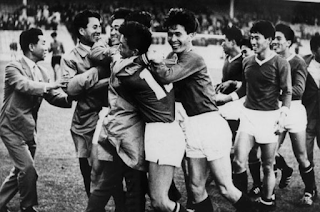
    • 1966 Soccer World Cup: North Korea upset Italy 1-0 in Middlesbrough, England, one of the biggest surprises in the history of the competition. North Korea advanced to the quarter finals (round of eight, only 16 teams advanced to the World Cup back then). In a memorable quarter final match, North Korea lost to a legendary Portugal side featuring iconic footballers Eusebio, Torres, Coruna and others, 5-3 after having been up 3-0 in the first half. Until South Korea qualified to the semi-finals (round of four) of the 2002 World Cup it co-hosted with Japan, North Korea’s 1966 performance was the best ever by an Asian team.
(Image Credit: Popperfoto/Getty Images)

Given that training is expensive for the regime and resources are scarce in North Korea, it is remarkable that these athletes have been able to win international competitions.[22] But their results are also the result of obsessively intense mobilization of available resources by the North Korean regime.

These athletes are pressured to win for the “glory of their Leader.” In 2012, during the London Olympics, North Korean medalists affirmed that their success was possible thanks to their leader, Kim Jong-un. Om Yun-chol, male gold medalist in weightlifting, said, “I won first place because the shining supreme commander Kim Jong-Un gave me power and courage.”[23] Again, in 2016, after winning the female gold medal for weightlifting at the Rio Games, Rim Jong-sim said, “The first thing I thought when I knew I had won was that I had made our beloved leader happy.”[24] Winners of gold medals are given the title of “Honorable Athlete” or “People’s Athlete” and receive gifts from the government, such as luxurious cars and houses.[25] The relationship between sports and the regime is not that several athletes belong to the army—this happens elsewhere in the world—but that the North Korean athletes are trained under the control of the State Physical Culture and Sports Guidance Commission, established in 2012 by Kim Jong-un. It was originally under the authority of the National Defense Commission (NDC), but is now under the State Affairs Commission (SAC), whose First Chairman was Jang Song-taek. After Jang’s execution, Choe Ryong-hae, one of the most powerful men close to the Supreme Leader, quickly filled the position of First Chairman.

Soccer in North Korea is controlled by the KFA, established in 1945 and directed by Ri Yong-mu, a Lieutenant General in the KPA.[26] The KFA is a member of both FIFA (since 1958) and AFC, the Asian Continental Federation (since 1954), but it does not follow their transfer regulations. Usually, soccer clubs make money from ticket sales, bonuses received from advancing in international competition, private donations, advertising sponsors, or from transferring their players. In North Korea, it is the government that finances the soccer clubs, essentially taking over the decision-making process and controlling the budget.[27] To emphasize, it is the regime which finances soccer clubs and is actually the only institution with the money to do so. Moreover, the Department of Sports, which has hegemonic control over all sports, is a KWP office. Thus, when a club buys a North Korean player, it is essentially handing money to the Kim regime.

In 2013, Kim Jong-un opened the Pyongyang International Football School, making his will to make soccer a top priority in the country very clear. With global attention on the North Korean nuclear program, sports are considered a chance to divert attention. With approximately 200 boys and girls from 10 to 14 years old, the soccer academy also functions as a school with classrooms, lecture halls, and dormitory rooms. However, only the most talented players are sent abroad, mostly to Italy and Spain, to receive professional training.[28] "We are training our students to become super-talented players who can surpass the skills of people like Lionel Messi," said Ri Yu-il, one of the school’s coaches. They are aware of the great importance of foreign expertise, and for this reason, the men’s national team manager is a Norwegian coach, Jorn Andersen. Nonetheless, Andersen recognizes how difficult it is to train players who cannot go outside the country to compete against better-trained international players. In North Korea, young players can only learn and study the techniques of great players, such as Zinedine Zidane, Lionel Messi, and Cristiano Ronaldo, by watching videos on CDs and USBs on their computers[29]. "My national players are with me but they don’t get match practice. They are always training, training, training ... but they don’t play matches," Andersen affirms.[30]

Half the stadium’s seats are assigned to civilians—who in summer all wear white hats, white shirts and red ties—while the other half is allocated to the military. Match marshals control the crowd with flags, instructing them to chant or applaud with wooden mitten clappers […] After every goal the crowd claps in unison and—if the Supreme Leader is present—the whole of the scoring team rushes forward to stand before him and salute.[31] This is how Ri Myong-guk, a soccer player from Pyongyang City Club, described a match in North Korea.

Attending a soccer match in Pyongyang is like attending one of the national parades honoring the Leader. One must cheer for the national team as one would cheer for the North Korean regime. To make matters worse, supporting and participating in these soccer events is demanding and expensive. People simply do not have enough money to attend matches in Pyongyang and are not able to go abroad to support their national team. Furthermore, the shortage of electricity means that during global sporting events, watching soccer matches on television is difficult and exclusively for the elite.[32]

In 1966, North Korea beat Italy during the World Cup in England, granting the DPRK national team international media attention. However, it was not until 2002 that a BBC crew obtained authorization for entering North Korea to film a documentary on the team entitled “The Game of their Lives.”[33] After ten months of training—including a tour in Russia—the North Korean players demonstrated their skills and shocked the world with their fast game, named after North Korea’s, Stakhanovite public mobilization campaign, Chollima, under Kim Il-sung.

After this incredible result, it took the DPRK national team 44 years to qualify to another World Cup, making it to South Africa in 2010, where only 50 North Korean citizens were allowed to attend in person to support their team. This time, the result was different, as the DPRK national team ended as the worst performing team in the World Cup.[34] According to the U.S.-based Radio Free Asia, the team was subjected to six hours of public mauling for "betraying" the communist nation's ideological struggle. The team coach, Kim Jung-hun, was accused of betraying the Leader’s son, Kim Jong-un. Winning would have been attributed to Kim Jong-un in an attempt to build support among the military and KWP members for the imminent power transfer.[35] FIFA was asked to investigate the accusation. After an investigation, FIFA claimed that the accusations were “baseless” and in a letter to FIFA, the Korean federation claimed that the coach and team were “training as usual” to take part in the 16th Asian Games.[36] Besides assurances that
FIFA had “checked all of its sources,” no evidence of coach or team safety was provided.

This was not the only issue North Korea has encountered with FIFA. Some members of the DPRK women’s team were banned from the 2015 Women’s World Cup for steroid use—the result of a traditional medical treatment called musk deer gland[37] therapy.[38] Furthermore, FIFA’s issues with North Korea have steadily extended into the political realm. In 1966, there were problems getting the DPRK national team to England to play against countries that did not officially recognize the nation.[39] However, over the past 14 years, FIFA has provided North Korea with a total of $2 million in funding, $450,000 of which was delivered in 2001 to improve the Kim Il-sung Stadium in Pyongyang.[40] Funds were also allotted to upgrade the training camp for the national soccer team, the headquarters of the North Korea Football Association, and to open the International Soccer School for children under 13 in 2014. Last year, an additional $7,678 was provided for domestic soccer development, maintaining fields, and training adolescents and referees. However, policy changed following the nuclear tests in 2006 and 2009, and the satellite launch in 2012. Finally, in March 2015, FIFA renounced its plans to provide $1.66 million in financial assistance to the North Korean Football Association. This funding would have come from FIFA’s Financial Assistance Program (FAP), intended for nations that lack the resources to support a national soccer program.[41] FIFA is based in Switzerland and has to respect the sanctions of the Swiss State Secretariat for Economic Affairs (SECO), implementing and intensifying UN sanctions and travel bans on North Koreans suspected of having ties to the country’s nuclear program. For these reasons, FIFA is no longer able to provide North Korea with financial assistance.[42]

This analysis is not intended to dismiss the importance of cooperation in soccer or other sports. The scope of this analysis is rather, to argue that when it comes to North Korea, sports simply cannot be separated from politics. In North Korea, political considerations dominate every single aspect of life in the country. Nevertheless, despite the threat North Korea poses to international peace and security, both inside and outside the country, the DPRK national team was able to play in the qualifiers for the 2018 Russia World Cup.[43] Soccer clubs all over the world still conduct negotiations with suspicious North Korean clubs. Han’s team, Cagliari Club, is hosting and training another young North Korean player, Pak Yong-gwan (born in 1998), who comes from the same club, Chobyong.[44]

The Italian government has neither direct links nor apparent relations with the North Korean regime. But ignoring the atrocities committed inside the country is unacceptable. Hosting and paying two, three, or even ten soccer players in Italy may not provide massive financial assistance to the North Korean regime, but conducting any business with the North Korean authoritarian dictatorship should be taken much more seriously by the Italian government.

Italy has a diplomatic and political role in the international community and has recently implemented the UN’s sanctions on North Korea—withholding approval for the entrance of newly-appointed North Korean diplomats into the country and forcing some North Korean students in Italy to change their major from nuclear-related issues.[45] Moreover, on January 1, 2017, Italy became a non-permanent member of the United Nations Security Council, meaning that it should set an example for the international community in regards to implementing and respecting United Nations sanctions. Controversy should be avoided. Even if soccer organizations are allegedly not directly affiliated with the government, they are under strong regime control in North Korea.

Of course, Han and Choe are not the problem. Instead, Han and Choe could be the solution. They are not just great soccer players, they are human beings, and they should not be used as propaganda tools, hiding and diverting attention away from the ongoing atrocities committed within their country.

In Italy we have consulates and embassies of countries persecuted for violating human rights. Eritrea, for example, and North Korea. It is important for the government to always raise up the human rights issue, whenever it is possible, during bilateral meetings with representatives of these countries. When human rights violations occur on our territory, it is everyone’s duty to inform the government. Those people, in Italy, must be free and enjoy all rights. I cannot understand why Italian athletic societies can authorize these kinds of behaviors or requests from such countries.” 

-Lia Quartapelle, Partito Democratico (PD) Deputy.[46]


--------

[1] Translation. “Razzi: Visto Han? Dei nordcoreani bisogna fidarsi”, Gazzetta dello Sport, April 26, 2017, http://www.gazzetta.it/Calcio/Serie-A/26-04-2017/razzi-visto-han-nordcoreani-bisogna-fidarsi-190994822513.shtml.
[2] Forza Italia is an Italian moderate-right wing’s party, whose ideology includes the Christian-democratic values and liberalism. Its president, since the foundation in 1994, is Silvio Berlusconi (former Italian Prime Minister), official website http://www.forzaitalia.it/index.htm. Senator Razzi is a member of Forza Italia and was elected at the Italian Senate in 2013; recently, he was nominated Secretary for the Senate Defense Commission, http://www.senato.it/leg/17/BGT/Schede/Attsen/00023054.htm.
[3] Christine Kim, edited by Hugh Lawson, “South Korea’s Moon Suggests Regional Bloc Including North Korea Hosts 2030 World Cup”, The New York Times, June 12, 2017, https://www.nytimes.com/reuters/2017/06/12/sports/soccer/12reuters-soccer-worldcup-southkorea-northkorea.html?_r=1
[4] Video. AFP news agency, November 4, 2016, https://www.youtube.com/watch?v=FD4FqthB8SA.
[5] Lega Nord is an Italian right-wing party founded in 1989, whose ideology includes federalism, social conservatism and anti-globalization; they ask for the independence of Padania, a huge territory consisting in several regions in the north of Italy; among their political proposals they also ask to leave the European Union (EU), and to close the borders to immigrants. Official website http://www.leganord.org/index.php.
[6] Giulia Pompili, “Che succede se arrivi alla Fiorentina da Pyongyang? Storia incredibile di mr Choe”, Il Foglio, March 22, 2016, http://www.ilfoglio.it/esteri/2016/03/22/news/che-succede-se-arrivi-alla-fiorentina-da-pyongyang-storia-incredibile-di-mr-choe-94044/.
[7] Giulio D’Alessandro’s blog, http://www.dalessandroscouting.com/han-kwang-song.html.
[8] Fundaciớn Marcet is a football academy founded in 1978 by Javier Marcet – a retired football player who played in Real Madrid and F.C. Barcelona – whose purpose is to spread globally the so-called Plan Marcet: an innovative pedagogical method for an intelligent football, based not only on the physical training but also on the academic education and the teaching of human values. The academy offers training for future football players and coaches. http://www.fundacionmarcet.org/index.php?option=com_frontpage&Itemid=1
[9] The Italian academy offers to young athletes U18 from all over the world international scouting programs.
[10] There is barely no information on the Chobyong Sports Club. It is under the DPRK Korea Football Association (PRKFA) (http://www.football-talents.co.uk/Chobyong_Sports_Club-26_27-2-102-19984.html), which is the governing body of football in North Korea, founded in 1945 and accepted into FIFA in 1958. (https://eaff.com/10fa/dprkorea/)
[11] Giulia Pompili, “Che succede se arrivi alla Fiorentina da Pyongyang? Storia incredibile di mr Choe”, Il Foglio, March 22, 2016, http://www.ilfoglio.it/esteri/2016/03/22/news/che-succede-se-arrivi-alla-fiorentina-da-pyongyang-storia-incredibile-di-mr-choe-94044/.
[12] Fedor Tertitskii, “North Korean footballers in Russia”, DailyNK, February 2, 2009, http://www.dailynk.com/english/read.php?cataId=nk00100&num=4510, the author mentions it as “NSA,” but the standard HRNK translation is “State Security Department (SSD).
[13] Giulia Pompili, “Che succede se arrivi alla Fiorentina da Pyongyang? Storia incredibile di mr Choe”, Il Foglio, March 22, 2016, http://www.ilfoglio.it/esteri/2016/03/22/news/che-succede-se-arrivi-alla-fiorentina-da-pyongyang-storia-incredibile-di-mr-choe-94044/.
[14] “Can N. Korean footballer join Serie A amid sanctions?”, Yonhap News Agency, March 7, 2017, http://english.yonhapnews.co.kr/focus/2017/03/06/86/1700000000AEN20170306012200315F.html.
[15] Luca Gunby, “Kwang Song Han: the First North Korean To Score In Serie A”, Forza Italian Football, April 13, 2017, https://forzaitalianfootball.com/2017/04/kwang-song-han-the-first-north-korean-to-score-in-serie-a/.
[16] Translation. Paolo Tomaselli, “Han, da Pyongyang a Cagliari per scrivere la storia”, Corriere della sera, April 10, 2017, https://www.pressreader.com/italy/corriere-della-sera/20170410/282587377836177.
[17] Yoon, Y., and Lee. S., “Human Rights and North Korea’s Overseas Laborers: Dilemmas and Policy Challenges”, Database Center for North Korean Human Rights, 2015.
[18] Traduzione. “Han Kwang-song: sul suo tesseramento in rossoblù interrogazione parlamentare”, L’Unione Sarda.it, March 3, 2017, http://www.unionesarda.it/articolo/sport/2017/03/03/han_kwang_son_presto_rossobl_sul_suo_tesseramento_un_interrogazio-4-574932.html
[19] The official name is Serie A TIM and it is Italy’s top soccer league since 1929. Official website http://www.legaseriea.it/it
[20] “Han Kwang-song, primo nordcoreano a segnare in serie A: merito di Antonio Razzi”, Libero, April 10, 2017, http://www.liberoquotidiano.it/news/sport/12354292/han-kwang-song-calciatore-nordcoreano-cagliari-gol-record.html.
[21] Brian Benedictus, “Golf and Lighting: the Odd Realm of North Korean Sport”, The Diplomat, August 28, 2014, http://thediplomat.com/2014/08/golf-and-lightning-the-odd-realm-of-north-korean-sport/.
[22] Jinhyok Park, “Ask a North Korean: How is sport viewed in the DPRK?”, NK News, July 14, 2016, https://www.nknews.org/2016/07/ask-a-north-korean-how-is-sport-viewed-in-the-dprk/.
[23] Louise Boyle, “Dear Leader, we’re doing great in London: How did North Korea end up sitting FIFTH in the Olympics medal table?”, The Daily Mail, August 1, 2012, http://www.dailymail.co.uk/news/article-2181855/Olympics-2012-North-Korea-fifth-medals-table.html.
[24] “North Korean weightlifter says Olympic gold will make ‘beloved’ Kim Jong-un happy”, The Guardian, August 13, 2016, https://www.theguardian.com/sport/2016/aug/13/north-korean-weightlifter-says-olympic-gold-will-make-beloved-kim-jong-un-happy.
[25] Jinhyok Park, “Ask a North Korean: How is sport viewed in the DPRK?”, NK News, July 14, 2016, https://www.nknews.org/2016/07/ask-a-north-korean-how-is-sport-viewed-in-the-dprk/.
[26] Danny Nazareth, “The curious case of North Korea’s national football team”, Sportskeeda, October 30, 2015, https://www.sportskeeda.com/football/curious-case-north-korea-national-football-team.
[27] “North Korean football: a big mystery of FIFA football”, The Paths Less Travelled Blog, January 14, 2011, https://thepathslesstravelled.wordpress.com/2011/01/14/north-korean-football-the-big-mystery-of-fifa-football/.
[28] “Pyongyang football school opens to foreign tourists”, NK NEWS.ORG, June 24, 2014, https://www.nknews.org/2014/06/pyongyang-football-school-opens-to-foreign-tourists/ .
[29] Jinhyok Park, “Ask a North Korean: How is sport viewed in the DPRK?”, NK News, July 14, 2016, https://www.nknews.org/2016/07/ask-a-north-korean-how-is-sport-viewed-in-the-dprk/.
[30] Agence France-Presse, “Pyongyang International Football School: The academy aiming to produce North Korea’s Lionel Messi”, The National, Sport, November 15, 2016, http://www.thenational.ae/sport/asian-football/pyongyang-international-football-school-the-academy-aiming-to-produce-north-koreas-lionel-messi.
[31] Rory Mclean, “A day in the life of North Korean footballer Ri Myong-guk”, The Guardian, May 14, 2015, https://www.theguardian.com/world/2014/may/15/north-korean-footballer-ri-myong-guk.
[32] Jinhyok Park, “Ask a North Korean: How is sport viewed in the DPRK?”, NK News, July 14, 2016, https://www.nknews.org/2016/07/ask-a-north-korean-how-is-sport-viewed-in-the-dprk/.
[33] Daniel Gordon, “the Game of their lives”, 2002, https://www.youtube.com/watch?v=rG-ivV-ps50.
[34] “North Korean football: a big mystery of FIFA football”, The Paths Less Travelled Blog, January 14, 2011, https://thepathslesstravelled.wordpress.com/2011/01/14/north-korean-football-the-big-mystery-of-fifa-football/.
[35] Justin McCurry, “North Korea’s failed World Cup footballers undergo public mauling”, The Guardian, July 30, 2010, https://www.theguardian.com/world/2010/jul/30/north-korea-footballers-public-mauling.
[36] “North Korea cleared of ‘foul’ play by FIFA”, CNN, August 26, 2010,http://edition.cnn.com/2010/SPORT/football/08/26/world.cup.korea.coach.assurances/index.html.
[37] The gland comes from musk deer living in a large area of Asia, from Siberia to North Korea. The hairy gland is 4cm and it is usually cut open to extract a liquid used for medical purposes. As a matter of fact, it is classified as a resuscitation-inducing aromatic herbs that can stimulate central nervous system if taken orally or relieve pain and reduce swelling in external application.
[38] Jinkuk Kim for RFA’s Korean Service. Translated by Yunju Kim. Written in English by Joshua Lipes. “FIFA to withdraw Funding For North Korean Soccer Develpoment”, Radio Free Asia, March 12, 2015, http://www.rfa.org/english/news/korea/fifa-03122015144548.html.
[39] Daniel Gordon, “the Game of their lives”, 2002, https://www.youtube.com/watch?v=rG-ivV-ps50.
[40] Ibid.
[41] “FIFA to Withdraw Funding For North Korean Soccer Development”, Radio Free Asia, March 12, 2015, http://www.rfa.org/english/news/korea/fifa-03122015144548.html.
[42] Ibid.
[43] The DPRK team was eliminated in Round 2 of the qualifying campaign, in June 2015.
[44] Translation. “Calciomercato Cagliari, Pak Yong-gwan è il secondo nord-coreano”, Sky Sport, March 24, 2017, http://www.corrieredellosport.it/news/calcio/calcio-mercato/2017/03/24-23354972/calciomercato_cagliari_pak_yong_gwan_e_il_secondo_nord-coreano/?cookieAccept.
[45] “Italy implements sanctions on N. Korean diplomats”, YonhapNews Agency, April 10, 2017, http://english.yonhapnews.co.kr/search1/2603000000.html?cid=AEN20170310002500315&__s=nqizptkv2ihqtpfcq2yd.
[46] Translation. Giulia Pompili, “L’inchiesta del Foglio sul calciatore nordcoreano in Italia finisce in Parlamento”, Il Foglio, May 26, 2016, http://www.ilfoglio.it/italia/2016/05/26/news/linchiesta-del-foglio-sul-calciatore-nordcoreano-in-italia-finisce-in-parlamento-96601/.